Saturday, May 12, 2018

Reflections on winning the 2018 Flying Pig Half Marathon

I won. 
There are two things I don’t often get the chance to do in this life: travel through time, and accomplish exactly what I set out to. The first, obviously, is impossible—for now, anyway: Despite its fictional popularity, no physicist or garage-tinkering amateur has yet figured out how to transcend the limits of spacetime. You could say that the second is impossible as well: As human beings, frustratingly finite, perpetually imperfect, we never quite get exactly what we want. But on May 6, 2018, at the Cincinnati Flying Pig Half Marathon, I came just about as close to doing both as I think I ever have.

How, you might wonder first, did I travel through time on this day? Repetition. I ran this same race last year, and did okay: I was 4th in 1:13:23, a time that I accepted then because of the difficulties that preceded it, but which I knew I could improve upon in the future. I had not planned to run the Flying Pig Half again this year; my original plan for 2018 was to run a half in March, and run the Flying Pig Full in May, but life intervened. And so I came to the line of this race, almost exactly a year later, with everything about last year’s performance fresh in my mind.

Me, during last year's performance. 
But this time travel advantage did not only exist on race day. For once I had decided to do the race again, I could take into account certain things about the race this year that I did not know last year, from items as basic as race-day logistics all the way up to things like strategy and training. And perhaps the most important lesson I learned from last year’s race was this: Be ready for the brutal hills that dominate the race’s middle miles. Last year, I did not prepare for them adequately, and I suffered. Because of them, the middle of the race quite nearly destroyed me, and I required a near-miraculous comeback just to finish. But this year, knowing that the race’s middle miles would be largely uphill, I could and did prepare for them, incorporating hill workouts into my training for the race. I thought it reasonable that I could at least use this foreknowledge to power myself to a PR: sub-1:12, certainly, sub 1:11, if I was feeling bold.

And how, you might wonder next, did I accomplish exactly what I set out to do? Well…I won. I was somewhat high on my chances of doing so before I even got to the starting line of today’s race: I was in good shape, better shape than last year, when I was 4th. I knew that many of my typical local competitors would either not be racing me, or, if they were, they would not be doing so at full strength, having just completed other races, such as the Boston Marathon, a few weeks before. This is why I came to the starting line with a not-unrealistic hope of victory. But victory itself still seemed a bit lofty a goal, almost too good to be true, for one of the biggest races of the year in my hometown. Against 13,000+ people, surely I would fall to at least one of them? But no. I did not. I won. And now I relate the story of my victory.

---------
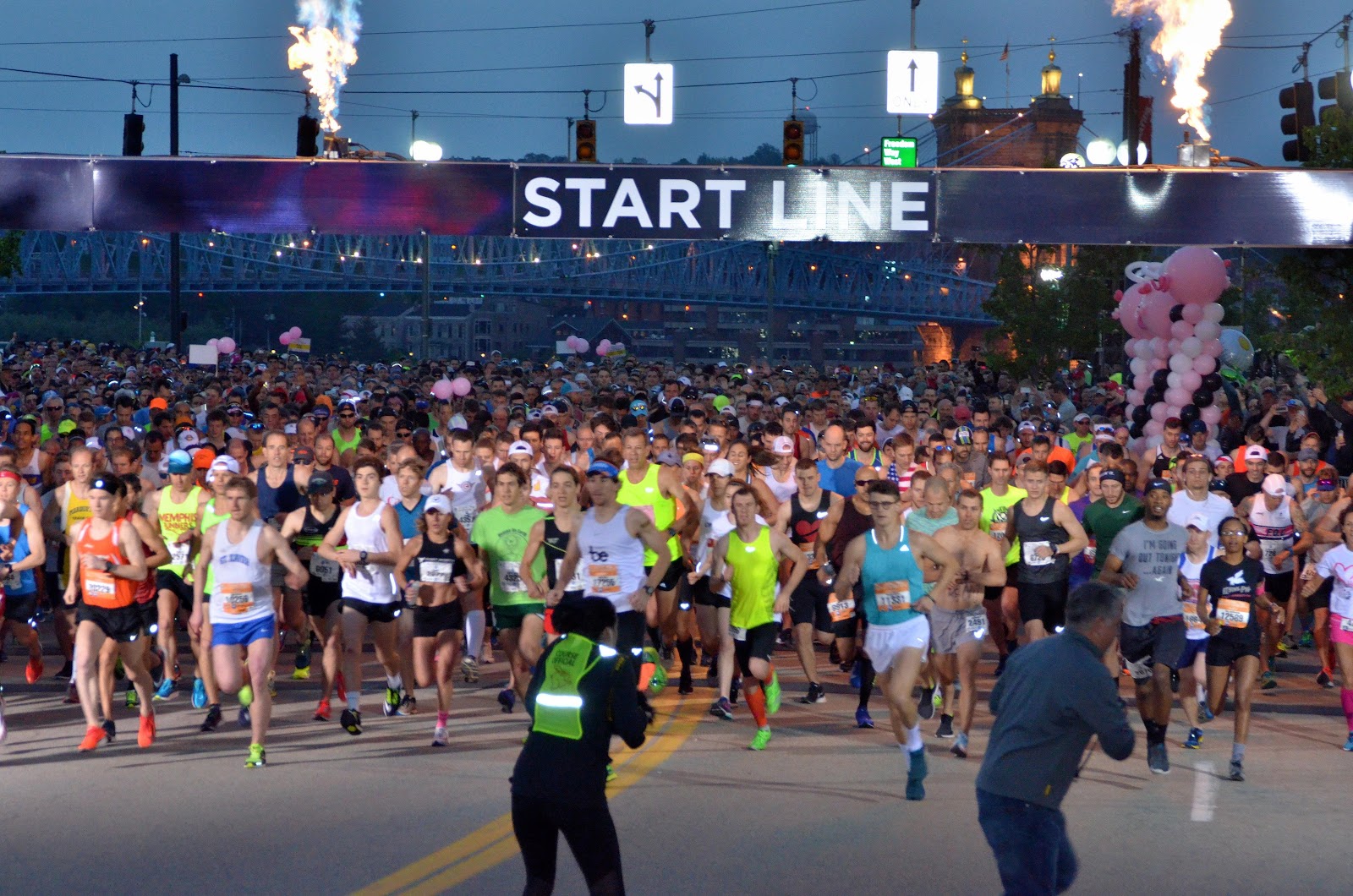
The starting line of the race. I am on the left, in the white and blue, already next to someone who would become important later.

With winning the race a realistic but by no means certain outcome, I started it at the very front. My tentative strategy, again, influenced by last year’s race, was to start out a little faster than I did last year, to hold on for dear life up the hills, and then finish as fast as I could, when the race became downhill/flat. If this meant running the race entirely alone, then so be it; if this meant dueling one or more fellow elites, I was fine with that as well. And not long after the starting gun went off, and the flamethrowers atop the starting line let loose (yes, this race has starting line flamethrowers), I discovered that I would not be alone. It only took about 800 meters, in fact, for my main competition to reveal himself. He and I settled quickly alongside one another behind the lead vehicle, which also had a timer, as we made our way through the early portions of the race. I checked my watch nervously, perhaps obsessively, during this first mile, as we made our way into Newport, Kentucky*, just to make sure I wasn’t doing anything I didn’t want to do, either too fast or too slow. The first mile ended up being a 5:16, which was fine with me. So I decided I would remain alongside this mysterious competitor for as long as our interests seemed to align.

It was in mile 2, through Newport, that I began to wonder if I was perhaps a bit out of my league. According to my watch, we ran a 5:08 second mile together, which was…a little faster than I wanted to go quite yet. Despite the ample fan support (at one point, including a band, at which I shouted “Free Bird”), despite feeling fine (if ever so slightly bloated from a large dinner the night before), going this fast this early made me wonder if I hadn’t inadvertently decided to contest a true elite. So I chose to hang back from him just a little bit after this, to see what he would do. When he slowed down a little bit as we went up another bridge back into Cincinnati, I became a bit more confident in myself, and ran alongside him again, now having firmly decided I could do so. Mile 3 ended up being a 5:22, which, again, I was fine with.

Miles 4 and 5, back in Cincinnati, he and I spent mostly together. Mile 4, during which we were mostly alone, was another 5:16; mile 5, which cuts straight through the heart of downtown and supplies a gauntlet of spectators, was surprisingly slower, at 5:23. I was still feeling good at this time**, and my competitor was just behind me, drafting off of me but always seemingly moving somewhere I couldn’t see him by looking behind me. At this point, I was content with this arrangement, because I knew what was coming, and I don’t think he did. Yes, time travel does have its advantages. For while I was not certain he did not know that mile 6 began the race’s gauntlet of hills, I strongly suspected so, and that I might be able to use this information asymmetry to my advantage.

He was still right behind or right next to me as mile 6 (5:26) presented the race’s first truly grueling uphill, up Gilbert. And here, still feeling good, I used the accumulated experience of last year’s race and this training cycle’s multiple hill repeat workouts to power my way up the hill. It helped that, at this point, someone was playing the Rocky theme: I know it’s cheesy, but damn it, it’s inspirational, and I needed it. At this point, I could no longer sense my competitor’s presence directly behind me.
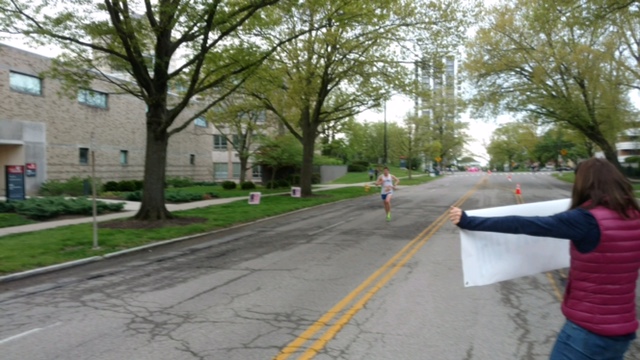
En route, with Mom cheering on the right. The sign says "Run, Jack, run!" It was good advice. 
Nor was anyone else, other than the lead vehicle, in front of me. I was alone, in first place, leading the entire field of the Flying Pig, as I headed into Eden Park, a little more than 6 miles into the race.
As Gilbert Avenue heads into Eden Park, the terrain flattens, but only briefly. Here, the first leg of the Flying Pig Marathon relay ends. When I saw the place where those people would make their exchange, whenever the first of them showed up, I could only think of one word: “bastards.” For unlike they, I had not just the rest of the race but, at that moment, arguably its most excruciating portion: the climb out of Eden Park. Last year, this was where the course broke me: I ran a mile above 6:00, became beset with cramps, and was on the verge of giving up before I dug deep within my soul to find the strength to recover. But this year, things were different. I was still feeling strong, I did not feel at all intimidated by being alone at the front or by the hill. I was ready to prove that I was stronger than I was last year.

And prove it I did. Ascending out of the park, I saw two of the same sights that marked my ascent last year: an Elvis impersonator, and a friend, Chris Reischel, cheering me on. Last year, in the delirium of my pain, or the pain of my delirium, these were almost surreal sights, intrusions into reality from some earthly, pain-free realm that at that moment forbade me access. This year, however, they were just spectators, motivators along my path. Soon I passed them by, and soon the course became (again, briefly) flat again, marking the 7th mile, by far the course’s toughest, which I completed in a 5:44. This was, obviously, slower than my other miles, but acceptable for that part of the race, especially versus last year’s supra-6:00 mile. The last of a series of three grueling uphills took me up Victory Parkway to East McMillan, another spectator-heavy portion of the race. It was here that I saw, for the first time, my parents and the sister who drove me to the race, dutifully cheering me on.
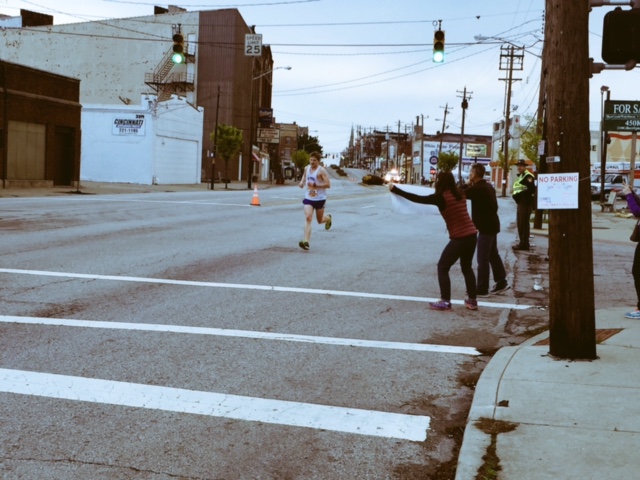
My parents (and my sister, sadly cut off, right edge) cheer me on during the hardest part of the race for me. My favorite picture from the race (courtesy Pete Anderson).

And I was glad of it. For although the race here became flatter, and the cheers of spectators became louder and more consistent, I needed all the support I could get. For after having conquered the race’s most difficult portion, I unexpectedly began to flag slightly here; if not too badly physically, as my miles remained acceptable, then certainly mentally, during miles 8-10 (5:28, 5:22, 5:26). I grew impatient with the race’s seemingly stubborn refusal to take me back in the direction of downtown, its insistence on continuing to force me up and down (smaller) hills and around turns. In short, I grew impatient, perhaps bored. I was helped here, again, by my fan support: I saw my family again, and also one Coach Emeritus Dehring, my St. Xavier High School track and cross country coach, the man who gave me the St. X singlet I wore today. There was also the fact that I could sense without looking behind me how close 2nd place was: Whenever I heard the spectators who had cheered me sounding up again, I knew that he was passing by them. And he was too close for me to rest on my laurels.  

Fortunately, this mentally taxing portion of the race ended soon enough. Beginning with mile 11, the course finally began to bring me back toward downtown, back down Gilbert. And this was where the fun began. That which I had struggled uphill earlier in the race now became an accelerator downhill. I was doubly helped in this regard by the fact that the bulk of the race seemed, at this time, to be heading up the hill, so it was lined with both spectators in the middle of the road and racers on the other side of me. Thus I got plenty of support as I raced down Gilbert, resulting in a 4:56 (!) mile 11. It’s an easy part of the race, yes, but a sub-5 mile is a sub-5 mile.


And yet the race was not over. For, I thought, there was no reason 2nd place wouldn’t be able to take just as much advantage of the downhill as I had. In fact, with me in his sights as the race entered its final portion, he might find even more motivation within himself to catch me than I would to remain in 1st. I had been in the front of the race now for 5 miles, but despite that, a terrifying paranoia began to beset me. So many times in my life had greatness been snatched from my grasp. I began to play in my head the nightmarish vision of being passed, or outkicked, and was not helped in this regard by being able to see my competitor’s orange singlet out of the corner of my eye any time I made a turn that allowed me to see him without breaking my stride.

But I did not let these dark prophecies destroy me. Instead, I turned them into the extra motivation I needed. I wanted nothing more, in the last two miles of the race, than to be able to coast to the finish line in victory. But the specter of 2nd place, in both its current bearer and the possibility that he would transfer his identity to me, terrified me into continuing to work hard. I was beginning to grow truly tired by now, but I knew that I couldn’t care. So I let this intoxicating mix of paranoia and victory lust spur me on.
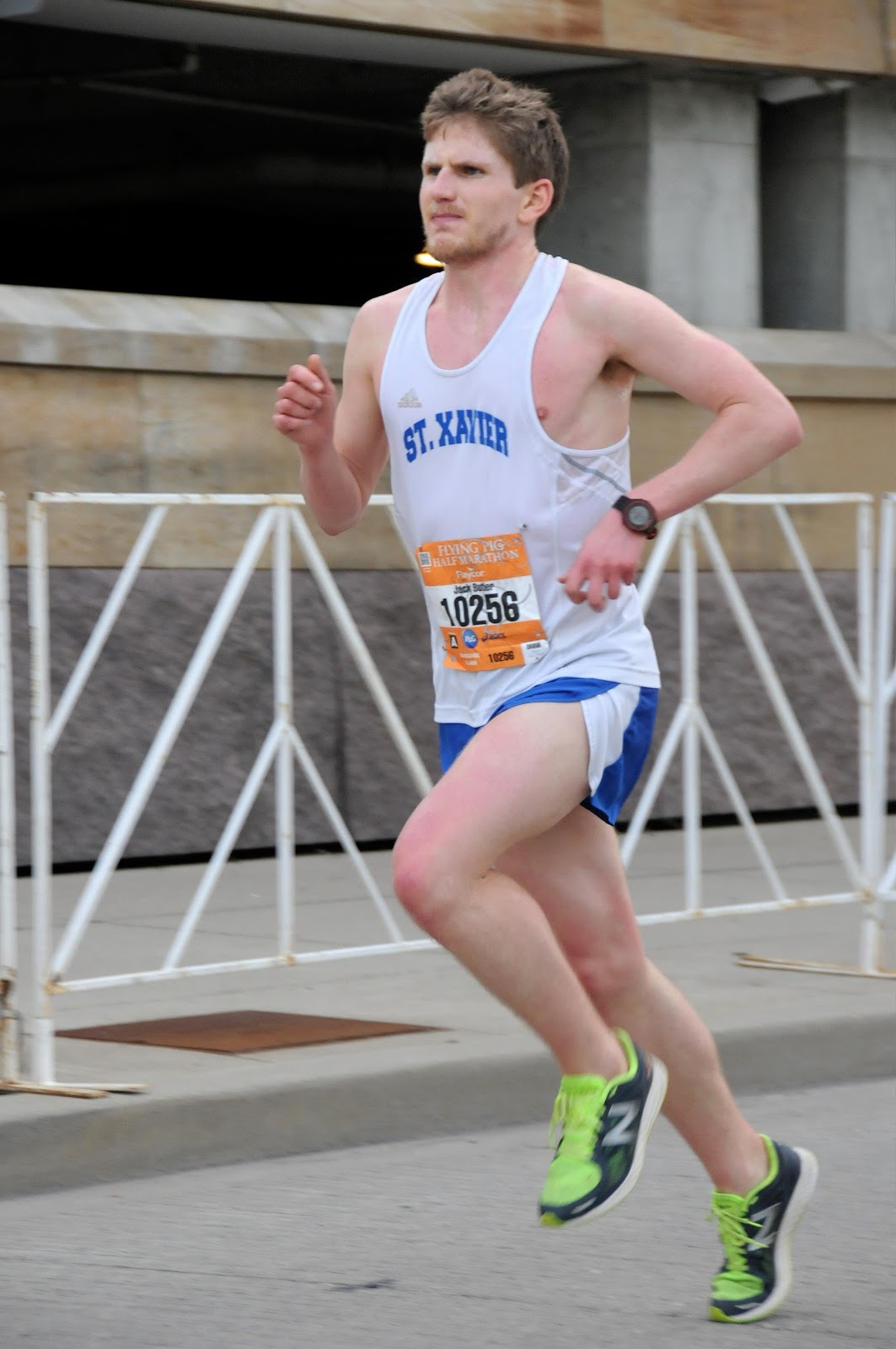
And looking good doing it. 
Just before the completion of mile 12 (5:05), the race performs a bizarre forced turnaround. Last year, when I went through this part of the race, it allowed 3rd place, on whom I had gained almost 40 seconds of ground in a furious kick, to see that I was closing in on him, which, alas, gave him the motivation he needed to keep that from happening. This year, it allowed me to see, again, that my orange-outfitted competitor was close enough that I needed to finish strong. I’m now convinced that this part of the course design is here precisely for this reason.

And so, in the last 1.1 miles of the race,*** I squeezed out every ounce of energy I had left. I was fortunate to know that the finish line of the race was different from last year. Getting lost or something like that was not my concern, not with the lead vehicle, the race spectators, etc. guiding me. But it was important that I knew, for my own mental purposes, that the finish line was not where I remembered it, but slightly further away. I continued to follow the lead vehicle and the race cyclist back toward the heart of downtown, with fewer meters to go with every step, but still without the finish line in sight. Around this time, roughly mile 13 (5:10), I randomly saw Brad King, who was pushing a baby in a stroller. A St.X alum, he cheered me on for my singlet, but was probably weirded out when I responded by pointing at him and saying “Brad King.” I do that kind of thing sometimes. But despite the distraction, I was starting to wonder if I would ever finish.
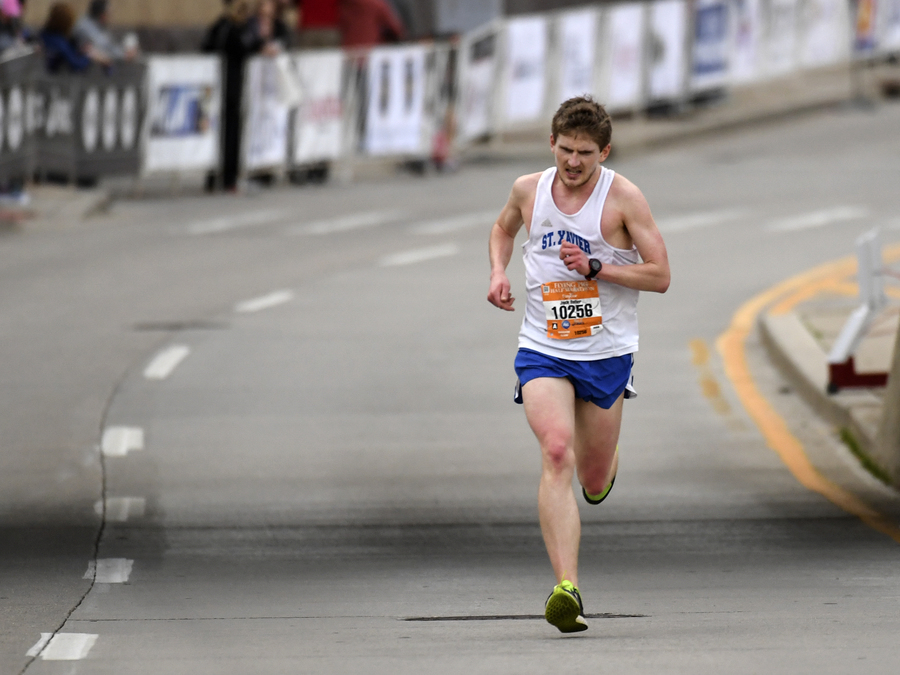
Approaching the finish. 
Then…there it was. Much further off than I expected, I could see the “Finish Swine,” with that unbroken race tape, waiting for me to be the one to break it. It was so close, yet so far away. The combination of that, and the departure of the lead vehicle from in front of me, as well as the cyclist who had been leading me, from the course, all combined to elicit a “shit” from my parched racing mouth. It was quite true what the cyclist said to me as he left the course: “You’re on your own for the rest.”

With 2nd place not worryingly close to me, with all the finish line’s spectators cheering me and me alone on, I charged toward the finish as hard as I could manage****. Even then, with victory obvious and imminent, I still couldn’t believe what was actually happening. I was still afraid of a last-minute surge from someone else that would take everything away from me just before the end, forcing me to watch as my glory was stolen before my very eyes, as has happened to me so many times before.
But that moment never came. Meters before the finish line, I crossed my arms in an X-formation, honoring my past (and my singlet). And then I crossed the line, broke the tape, and earned victory. With a time of 1:10:39, I was the 2018 Flying Pig Half Marathon champion, the first runner to cross the line for any race that day.
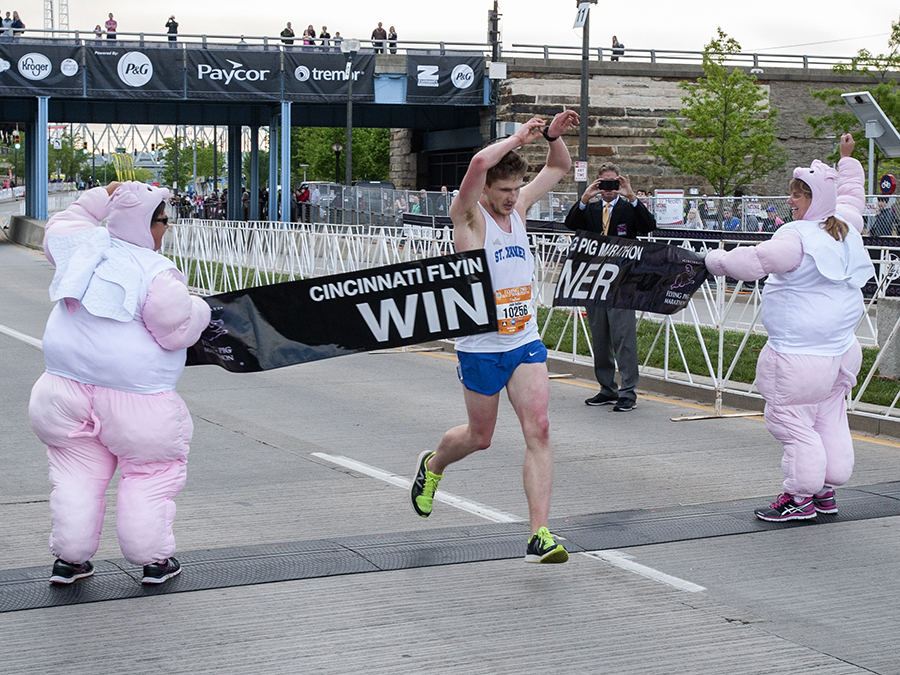
Crossing the finish. 
---------------

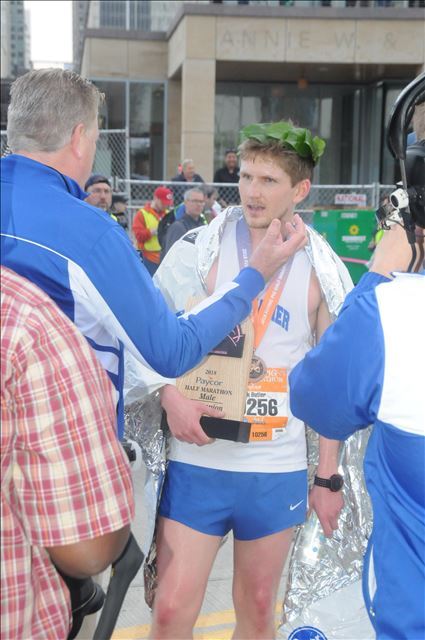
The post-race press tour begins. 
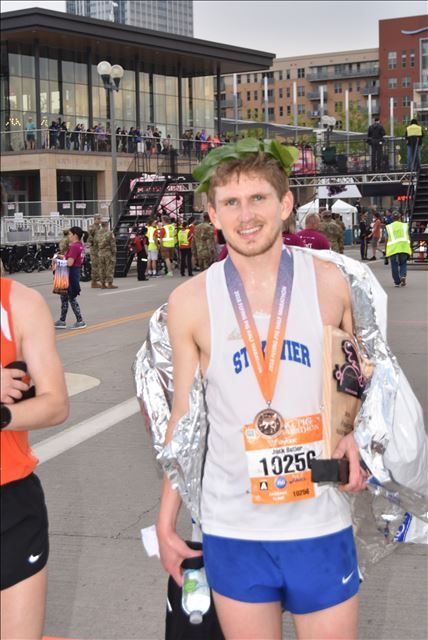
You might expect the immediate aftermath of such an experience to be something of a blur: Heady with victory, and exhausted from the effort, would the memories really stick? But I can assure you, they did. Just after I crossed the line, I was given my medal and plaque, the victory laurel was placed upon my head, and I was wrapped in one of those weird blanket things. I was then interviewed by WLWT, a local news station, in a surprisingly cogent performance for someone who just won a half-marathon. And fortunately for me, even if I did not remember what happened to me after I finished, it was all captured on the WLWT video of my interview, which you can watch here (also embedded below):


I spent a good 10-15 minutes after finishing in the finish line corral, doing more interviews, taking pictures, and talking with 2nd place. His name is Zack Beavin, and he ran a 2:30 at the Boston Marathon this year, so he was probably not at full strength. I told him as much when I learned that, in addition to thanking him for working with me in the race. I told him I couldn’t have done it without him, and I hold to that; we worked together through mile 6, and then the possibility that he might still beat me made me paranoid enough to finish strong. Thanks, Zack. May we run against each other again someday.

Half-marathon top 5. All results here.

Once I left the finish line corral, I was quickly found by my aunt and uncle, who were there to support my cousin Ben (their son), who was running the marathon, and me. They congratulated me, declined to hug me (because I was so sweaty), and graciously held some of the swag I had won when I decided to try going on a cooldown.

Pictured: spolia opima

Anyway, though…holy crap. I thought I might be able to win today. But I actually did it. No asterisks. No qualifications. And not only did I win. I blew my apparently modest goal of setting a personal record out of the water. Before today, my fastest half-marathon was the 1:12:40 I basically jogged in preparation for the Marine Corps Marathon last fall. So I dropped 2 minutes off my PR. And I dropped almost three minutes off my time on basically the same course as last year. I knew I raced last year not at full strength, but still…3 minutes! Wow. I don’t really have much else to say.***** When I dream about races, they usually end badly, with some last-minute catastrophe keeping me from victory. The aftermath of this race felt, at times, like a dream. But I knew it wasn’t, because in the dreams I never win. Thanks to the Flying Pig for making my reality better than my dreams.

I spent the rest of this day, as you might imagine, sore, tired, bowel-troubled, but completely and utterly satisfied. I’ve been running seriously for more than 10 years now, but I think this is by far one of my greatest running accomplishments yet.******

Winner winner bacon dinner. 
Let’s close with some more time-traveling. Last year, in the log/blog of myFlying Pig performance (5/7/17), I wrote the following:

“But the main takeaway about this race, for me and for everyone who know me (especially those who may compete against me), is that this won't be my last half-marathon. Indeed, it was only my first. And now that I have the experience under my belt, I expect only to get better and better at this race. For I have now proven, to myself and to anyone who may have doubted me, that graduating from college was not the end of my competitive running career.
It was only the beginning.”

2017 Jack was right, in more ways than he could have known. My competitive running career has only just begun. And though I, for once in my life, actually did exactly what I set out to do, let no one think this means I am done. There are other races to run, and to win. Tennyson put it better than I could:
Yet all experience is an arch wherethro' Gleams that untravell'd world whose margin fades
For ever and forever when I move.
How dull it is to pause, to make an end,    
To rust unburnish'd, not to shine in use!******* 

Now, if you’ll excuse me, it’s time to shine in use.

Notes:

*The Flying Pig uses for its first three miles the last three miles of the Thanksgiving Day Race, the last race I ran in Cincinnati.
**I drank slightly too much water early on in the race, and I felt ever-so-slightly waterlogged, so I stopped with it early on and never hydrated subsequently. I also had to be careful not to grab Gatorade by mistake, which I did last year and which I think negatively affected me.
***The Flying Pig uses for its last two miles the first two miles of the Thanksgiving Day Race, the last race I ran in Cincinnati.
****My watch says the last portion of the race for me was .31 miles, and that I ran it in 1:32.71. So I ran 13.31 miles in 1:10:40 (according to it), which is 5:19 pace. Man, I need to work on those tangents.
*****Other than this: According to my preliminary research into past Flying Pig Half Marathon results, my performance today ranks 6th all time:
Tommy Kauffmann - 1:08:30 (2017)
Chris Reis - 1:09:09 (2009)
Todd Pthlek - 1:09:22 (2008)
Thomas Lentz - 1:10:02 (2007)
Mike Griewe - 1:10:36 (2007)
Jack Butler - 1:10:39 (2018)

The funny thing is I know three of these people.
******I still have a tendency, a holdover from running in high school and college, to think of my running career in terms of “seasons.” In that sense, the Fall 2017 and Spring 2018 “seasons,” and the 2017-2018 “year” overall, have been among my best ever for running:
Fall 2017:
-September: Navy Air Force Half Marathon: 1:12:40, 9th
-October: Marine Corps Marathon: 2:34:29, 15th
-November: Cincinnati Thanksgiving Day Race: 33:07, 4th

Spring 2018:
-April: Cherry Blossom 10-miler: 53:15, 46th
-May: Flying Pig Half Marathon: 1:10:39, 1st
Not bad!
*******Unless I’m just totally hallucinating, I think I quoted this part of the poem from memory to one of the news crews that interviewed me at the finish line.

Sunday, December 31, 2017

'The Last Jedi' is better than the hate

Perhaps you've heard of this movie
When Star Wars: Episode VII - The Force Awakens came out in 2015, it brought a perhaps unprecedented level of hype and subsequent critical and commercial attention. There hadn't been a Star Wars movie in 10 years, and the last time there was one, it was the concluding chapter of the largely-loathed prequel trilogy, which also did not move forward the story last updated in 1983's Return of the Jedi.

The Force Awakens was also the first Star Wars movie to be released in what I call the "take economy," that large sector of the Internet (and other places, I guess, but mostly the Internet) powered by fans and obsessed with dissecting, reviewing, critiquing, and theorizing about pop culture. As a result, The Force Awakens generated a heretofore-unseen level of takes (some of them on this very blog). A large portion of these takes seemed critical of the movie, which I thought was mostly misguided, for reasons explained here.

The one criticism I granted some merit was that The Force Awakens seemed a bit...familiar. This critique deserves many, many qualifications. But the most important of them was that it would be impossible to judge The Force Awakens on its own merits, in isolation from the new trilogy of which it would be a part. As the first installment, it reacquainted us with the universe while also establishing the possibility for significant creativity and novelty in future installments. It would only be possible to judge The Force Awakens, then, and the new trilogy as a whole, upon its completion; too many critics were trying to judge aspects of its narrative best seen in conjunction in isolation, and in comparison with a trilogy already completed in 1983. This seemed unfair.

You may remember this movie
But with the release of Star Wars: Episode VIII - The Last Jedi, we have a better sense of how to judge this new trilogy. The Last Jedi has many of the trappings of a Star Wars film: there are lightsabers, wars in stars, Force powers, etc. But in many other ways, The Last Jedi actively subverts what we've come to expect from Star Wars, introducing new characters, new themes, and new scenarios and setpieces, and taking the story in surprising new directions. It is not entirely successful at all of this, largely due to a somewhat unfocused, flabby narrative (at 2 hrs and 30 minutes long, The Last Jedi is the longest Star Wars movie), and some creative risks that do not pay off. Yet the successes in this regard definitely outweigh the failures of what ultimately remains thoroughly a Star Wars movie.

The Last Jedi begins with its first subversion: It seems to take place immediately after the end of The Force Awakens (whereas all previous Star Wars movies have at least some gap between them), with the Resistance (the reduced successor to the original trilogy's Rebellion) on the run from the First Order (the not-much-reduced successor to the original trilogy's Empire). Meanwhile, Rey (Daisy Ridley) has arrived at the hideaway of Jedi Master Luke Skywalker (Mark Hamill), seeking his wisdom and his aid in the fight.

This setup seems at least somewhat redolent of The Empire Strikes Back, The Last Jedi's original trilogy equivalent. But The Last Jedi quickly takes this framework and moves it in strikingly different places. On the Resistance-First Order side of things, the Resistance, led by Leia Organa (the late Carrie Fisher) is in more dire straits than the Rebellion ever was, with a tiny fleet, led by brave but reckless pilot Poe Dameron (Oscar Isaac), and hounded by the First Order's relentless ships. And Rey finds, in seeking the counsel of Luke, that he has essentially given up on the Jedi (whom he considers failures), the Force (from which he has cut himself off), and the Resistance (which he thinks no one can help). And Rey, the seemingly eager pupil, finds herself mysteriously connected and drawn to the tormented villain Kylo Ren, a.k.a. Ben Solo (Adam Driver), who is likewise drawn to her.

They have a history
To reveal where The Last Jedi goes with all of this would be to ruin a movie you should definitely see for yourself (and perhaps more than once; it took me two viewings to appreciate fully). But it is not a spoiler for me to reveal that the movie takes the raw materials of its plot in unexpected and subversive directions. And perhaps the most impressive direction is a narrative theme that is more mature and complex than any previous Star Wars movie: failure. Virtually every character in the movie confronts failure in some way. Their reactions to their failures determine the directions of their characters: some learn from them, others take the wrong lessons from them, and still others fail to grow at all from them, to their own detriment and folly.

It would also not be a spoiler for me to reveal that the movie does new things with the trappings of Star Wars that keep its universe interesting in a fashion I no longer considered possible. You'd think there are only so many things to do with the Force, with lightsabers, with space battles, and with the basic dynamic of good-vs-evil. But The Last Jedi does fresh things with each of these archetypes, a testament to its creative risks.

Not all of The Last Jedi's creative risks pay off, however. It is too long and somewhat disorganized, a noticeable contrast to the clean, clear, three-act structure of The Force Awakens. It is somewhat too packed with ideas, many, if not most, of which are intriguing but not all of which get full exploration. Many of its deliberate subversions of fan expectations served to keep the story surprising, but some of them seemed a bit unfair, and deserve at least some addressing in Episode IX - The Spark of Hope (or whatever it's called). The Last Jedi also does not seem to know really what to do with Finn (John Boyega), who gets a bit lost in the sprawl of its narrative.

But these flaws do not add up to a movie that deserves the hatred many seem to have given it. It is absurd to claim it is worse than any of the prequels, or that any character in it is worse than Jar Jar Binks, but many have claimed precisely this. If these and other critics, in overabundant supply in the take economy, are angry at The Last Jedi for straying from their expectations of what should have happened, or deviating from their own fan fiction or fan theories (something to which I could have related, having written some fan speculation of my own), then they are misguided. If Star Wars only conforms to preestablished expectations, then it will stop being interesting very soon, in a galaxy very, very close to us. There are criticisms to be made of the The Last Jedi, but a failure to be interesting is certainly not one of them.

Thursday, November 30, 2017

'Stranger Things 2' focuses on the past, in more ways than one

*cue synth music*
It's hard to make a good sequel. Our pop culture landscape is littered with failed follow-ups, successors to what probably should have remained one-hit wonders. Some of these were bad enough that they not only destroyed themselves, but cast a retroactive pall on the original that spawned them.

As the decade that truly began the modern blockbuster, the 1980s produced sequels of its own: the original-justifying Empire Strikes Back, the middling Back to the Future Part II, the retread Ghostbusters II, and many others.

The cast and crew of Stranger Things 2 (self-stylized as such, not as Stranger Things: Season 2) surely had all of these examples in mind when they set about their work. For various reasons (explained at greater length here), Stranger Things became one of the biggest and most popular surprises of 2016. It could have been--and almost was--a literal one-off, a self-contained story that did not continue, but the Netflix overlords demanded more. And that meant the biggest question would not be one of the dangling threads left in tantalizing fashion by a one-time story. It would, instead, be a more classic inquiry: Can the sequel be as equal?

For now, the answer is (mostly) yes. I didn't think Stranger Things was quite the flawless masterpiece it was held out to be, and I think more or less the same of Stranger Things 2. It has many of the same strengths as its predecessor--a perfect atmosphere, excellent acting, cool sci-fi stuff--as well as many of the same weaknesses: questionable plotting, strange character decisions, and those darn kids. What make Stranger Things 2 a bit of a comedown from the first season, though, are an excess of ambition, as well as a sense of repetition that bodes ill for the future of a show with purportedly several seasons to go.

There's a lot going on here
One of the biggest weaknesses of Stranger Things 2--or so you might think--is the lack of a clear antagonist. The Hawkins Laboratory and its functionaries, as well as the beast from another dimension that they unwittingly unleashed, were the clear villains of the show's first season. Things have changed somewhat this time around: the Hawkins Lab, now personified by Dr. Sam Owns (80s film vet Paul Reiser*), is now more or less on the side of our heroes. And while this season tries to compensate for the lack of compelling human villains by multiplying the extra-dimensional beasts, their animalistic impulses can only frighten so much.

This is an apparent weakness, however, because Stranger Things 2 does not want the central villain to be anything concrete. The main foe the lovable residents of Hawkins, Indiana must face this season is, instead, the past. As befits a sequel to something that loomed so large in the pop cultural landscape as Stranger Things (and much of whose appeal derives from a backward-looking nostalgia), Stranger Things 2 makes it clear that its characters have not moved on from the events that transpired a year ago. Chief among them is Will Byers (Noah Schnapp). Will spent most of last season trapped in the Upside-Down, an alternate/parallel dimension from which all evil seems to spawn. And in the closing moments of season one, he vomited up a slug, flashed back to the Upside-Down, and then...acted like nothing was wrong. This bothered me immensely, as I thought it ridiculous that any main character in that show's universe would have any incentive to hide anything about the paranormal anymore. Fortunately, the show seems to have realized this. In the early parts of the second season, Will is openly discussing his lingering paranormal maladies (that have some connection with a lingering presence from the first season) with his mother Joyce (Winona Ryder), and with the consultation of Hawkins Lab. Much like the first season, the second season ends up being about Will. Physically absent for most of the first go-around, he is this time emotionally distant, and, finally, literally not present, merely a vessel for some evil from the Upside-Down. As Will, Schnapps not only proves himself a good fit for the famous kid ensemble that is the source of so much of this show's appeal (for reasons that are beyond me), but also worthily anchors an entire season more or less around a character we mostly only knew through inference before.

Noah Schnapp as Will Byers 
Will is not the only one dealing with the trauma of the past. Perhaps in response to fan reactions, Nancy Wheeler (Natalie Dyer), as well as Jonathan Byers (Charlie Heaton) and Steve Harrington (Joe Keery), the show's next level up of adolescents, are dealing with the trauma of having to lie to everyone--including her parents--about the death of the (in)famous Barb (Shannon Purser). As in season one, their characters' journeys, again, lead to some of the show's more cliched territory: teen sex, angry drunks, love triangles, and a conspiracy nut (Brett Gelman) of the sort whose absence from the show's first season seemed dubious to me. But that this trio would still feel lingering guilt over the aspect of the cover-up that most directly concerns them provides an intriguing dimension to the trauma-driven theme of Stranger Things 2.

Eleven (Millie Bobby Brown) and Chief Hopper (David Barbour) are dealing with the past as well. Following the events of the first season, Hopper has taken Eleven in secret, letting her live a clandestine but very real life with him while the world believes her dead. Tension inevitably results in this closed setting, itself representative of two ways to deal with trauma: to keep it bottled up or to let it all explode outward. In life, and in this season of Stranger Things the former obtains until the latter prevails.

To the extent Stranger Things 2 is a meditation, of sorts, upon dealing with the past, it succeeds. Where it fails, however, is in its increased ambitions. Sequels often are tempted to get bigger, to expand the universe, to do more. Some succeed at this, but not all. Stranger Things 2 tries this in several ways. A few of them are harmless, and even beneficial: expanded backgrounds and scenes for characters like Dustin, Lucas, and Steve Harrington; new characters who fit right into the show, like the thematically-named Bob Newby (Sean Astin, playing up and off his roles in The Goonies...and in The Lord of the Rings???**). Newby is not merely well-cast, but also supplies, in his aggressive normalcy, a glimpse for Joyce and others around her of what life could be like on the other side of chaos. Other expansions of the universe seem more like harmless but also thoughtless ratchetings-up of the dial: season one had some contemporary 80s music? Well, season two will have even more. Season one extensively referenced E.T. (among other things)? Season two will reference Aliens and The Exorcist.  Season one had one monster? Well, season two will have two, no three, no, like, six, no twelve...no...

At least you can't accuse the Duffer brothers of just introducing these guys for the toys
Other ambitious expansions seem more like straightforward misfires. A fractious pair of stepsiblings, fresh from California, introduce some contrived drama into the proceedings: Max, a redheaded girl (Sadie Sink), peer to the boys, introduces some prepubescent romantic tension into the lives of Dustin and Lucas, and Billy (Dacre Montgomery), a mullet-sporting heartthrob does...well, what, exactly? Pointlessly antagonize the main characters? Display all the dramatic depth of an after-school special? I greeted Billy's arrival onto the show with skepticism, but patience, hoping that some kind of payoff would result with his character, but none truly ever did. He could have been removed from the season without any harm to its arc.

But the biggest misstep of this season, one that has already been widely recognized as a sort of curious aberration, comes in episode 7. Eleven, smarting from her repression at the hands of Hopper, alights to the big city, where a psychic vision has promised potential reunion with a fellow experimental subject at Hawkins Lab. Meeting 8/Kali (Linnea Berthelsen) there, she finds her in charge of a random gang of 80s stereotypes, gets a makeover, and learns some things about herself before deciding it's not the life for her and showing up to rescue everyone in Hawkins just in time.

The Duffer brothers probably had in mind The Empire Strikes Back when they created this Eleven side adventure (and hopefully not a backdoor pilot). There are certainly clear indications of that, especially when Eight successfully trains Eleven to lift a heavy object Eleven thought she couldn't lift herself ("do or do not...there is no try"). They borrowed another aspect of The Empire Strikes Back as well: using events to split up the main characters for the duration of the story, and making the dramatic climax hinge on their reunification. This is basically what happens in Stranger Things 2, when Eleven's return to all of the main characters sets in motion the simultaneous resolution all of the second season's troubles.

It's important to know your roots
It has to stumble through some awkwardness to get to that point, although maybe this is just the sort of thing that bothers me and me alone about the show. Why, for example, do the "demidogs" hunt and threaten only the show's main characters? Why, when some of those characters tried to lure them with raw meat, did not other predators (coyotes?) take the bait? Why do the boys continue to insist that their Dungeons and Dragons expertise (as well as anything else about their persons, really) equip them to face this threat?*** Why did Dustin, who faced off against a literal monster in the first season, become so endeared to one of them this time around? How, in the tripartite climax, do the kids conveniently know exactly when to distract the demodogs from the other players in the plot? These and a couple other little questions sufficed to take me out of the show in considering them. They also underline one of the main ways in which season two's excess of ambition undermines itself: It's often like the show has plotted so much that it forgets that other things are happening at the same time as one another, or that they need to make sense instead of merely hurtling toward a climax.

The end goal of the Duffer brothers, one presumes, was to create another Empire Strikes Back: a darker, fuller sequel that at once expands upon and justifies the original. At a surface level, one can say they have done that. But it doesn't take much to go below that surface and find a product that is more Ghostbusters II than Empire Strikes Back: i.e., more of the same. Stop me if this sounds familiar: Will is in trouble, other people have strange ways of communicating with him, someone hides Eleven, Eleven saves the day, monsters threaten them from another dimension, the season ends with a hint of greater evil. All describe the basic beats of season one. For the time being, Stranger Things can get away with this; its cast and crew have the talents to make it interesting. Eventually, though, the mystery and the teases need payoff. Otherwise, Stranger Things may end up another one of those failed sequelized properties that litter our pop cultural landscape.
  
*Perhaps Paul Reiser's most famous role is the smarmy corporate hack in Aliens who eventually gets killed by one of the titular beasts. If you've seen Aliens and watched Stranger Things 2, you'll know exactly what scene in the latter plays on his role in the former.
**Whether intentional or not, several scenes in Stranger Things 2 seemed quite similar to scenes from Peter Jackson's Lord of the Rings trilogy, in which Sean Astin played Samwise Gamgee:
-A character death occurs in a fashion strikingly similar to that of Gandalf in Fellowship
-
Eleven's convenient return has echoes of Gandalf the White's reappearance in The Two Towers
-A final climax involving one group distracting monsters from a pair who have the power to destroy evil for good is basically the same way that Return of the King ends
***For me, one of the most satisfying moments in the whole show so far comes when Hopper basically tells Dustin to shut up after Dustin pointlessly compares a monstrous creature in the real world to something that exists in the Dungeons and Dragons universe.

Thursday, October 26, 2017

Season one of 'Stranger Things' felt both familiar and new

*cue synth music*
There is a very meta, almost fourth-wall-breaking scene at the end of season one of Netflix's hit series Stranger Things. After reuniting with their long-lost friend Will (Noah Schnapp), young boys Mike (Finn Wolfhard), Dustin (Gaten Matarazzo), and Lucas (Caleb McLaughlin), sit down with him for a "campaign" of Dungeons and Dragons, run by Mike. The campaign ends in dramatic fashion, but it leaves some of the group unsatisfied:

Dustin: "Whoa, whoa, whoa whoa whoa whoa....that's not it, is it?"
Mike: "No...there's a medal ceremony..."
Dustin: "Oh a medal ceremony! What are you talking about?"
Lucas: "Yeah man. The campaign was way too short."
Will: "Yeah."
Mike: "It was ten hours!"
Dustin: "But it doesn't make any sense!"
Mike: "It makes sense!"
Dustin: "Uh, no. What about the lost knight?"
Lucas: "And the proud princess?"
Will: "And those weird flowers in the cave?"
Mike: "I don't know...

Shown as part of the epilogue for season one's finale, this exchange is surely meant to be something of a nod at the audience. It certainly represented how many viewers felt after watching the first season of Stranger Things: wanting only more, and desperate for answers to the lingering questions that remained. The show, created by Matt and Ross Duffer (the Duffer Brothers), snuck onto Netflix in midsummer 2016. Supported by powerful word of mouth and intense binge-watching, Stranger Things quickly grew in popularity and became perhaps the dominant pop culture phenomenon of summer and fall 2016. And with season two premiering this Friday, it's a good time to look back at what attracted people to the show in the first place, and to guess whether season two can measure up.

The poster for season one, looking very 1980s
Season one centers on the mysterious disappearance of Will, and the nearly simultaneous appearance of a mysterious girl, who only knows herself by the name Eleven (Millie Bobby Brown). As adults and children alike try to find Will, the boys at the center of the story discover that Eleven holds many mysteries, and all involved must come to terms with the entry of the mysterious and the paranormal into their lives. And looming suspiciously over it all, a modern version of the Transylvanian castle on the hilltop with lightning striking behind it, is the Hawkins National Laboratory. Supposedly an innocuous research facility affiliated with the Department of Energy, adults and children alike soon conclude it may be the source of far (ahem) stranger things.

The source of the stranger things in Stranger Things.
The setting of Stranger Things goes a long way to explaining its appeal. The story takes place in the fictional town of Hawkins, Indiana, in 1983, creating the perfect backdrop for the kind of Spielbergian/Stephen King-esque story the Duffer Brothers want to tell. Our pop cultural moment is somewhat obsessed, for reasons beyond the scope of this post (but not this one!), with recreating both the actual past of the 1980s as well as the fictional interpretation of that past (then present) portrayed in such films as E.T.: The Extra-Terrestrial, The Goonies, Gremlins, and others. (See here for a more explicit comparison of all the 70s/80s pop culture that Stranger Things hearkens back to.) It is a time of a smaller, less intimidating, pre-cell phone/Internet America, of small towns and bikes and walkie-talkies with your neighbors, of overbearing parents and untrustworthy adults, and of kids who discover entire worlds unseen or misunderstood by the authority figures in their lives. The kind of gauzy, midsummer-just-before-sunset world evoked by these movies has so merged with the actual lived experience of those who really lived the era they depict that they are essentially becoming one in our cultural perception.   

This is also the world of Stranger Things. And it is perhaps our foremost current recapturer of that somewhat ineffable 1980s vibe. A close attention to little details helps: what people were wearing, how they talked, what they talked about, how they behaved, how they filled their time, what houses they lived in, what jobs they worked, how families interacted, what kids did--Stranger Things credibly recaptures all of these minutiae of 80s Midwestern life (or so it seemed to me, though I wasn't alive then). This is all reinforced by strikingly old-fashioned (which now, unfortunately, mostly means "competent") production. I think mostly of the extensive long takes and match cuts that dominate the cinematography of the first season, techniques that require actual craftsmanship and planning rather than the staccato rapid-fire editing common today. Also helping the atmosphere is the now-famous soundtrack (by Kyle Dixon and Michael Stein of the soundscape band Survive), a moody, expressive, ambient presence throughout the season that feels both modern in its technical complexity and a throwback in its themes and tones. Thanks to all this, the 1980s of Stranger Things feels real, regardless of whether it's the 1980s we actually lived in, or the 1980s the pop culture of that era, on which we now look back fondly, tells us we lived in.

For some parents, the lack of supervision these 80s kids enjoyed may have been the scariest part of the show
Stranger Things is also driven by some strong performances by its cast. Winona Ryder, returning to the 80s in fiction after starting her career there in fact, is by far the standout performer of the first season. As Joyce Beyers, the mother of Will, her maternal motivation to find and rescue her son is the season's emotional core. Her persistence in believing him alive, despite much evidence to the contrary, and despite what many around her quite rationally interpret as evidence of her unraveling sanity, gives us a strong, complex character in which to invest. One of her few adult allies is Jim Hopper (David Barbour), the chief of the Hawkins Police Department, a gruff yet mysteriously damaged man whose efforts to get to the bottom of Will's disappearance lead him down more rabbit holes than he anticipated. These two adults are compelling, dynamic characters whom I wanted on the screen every time they were off, and who made any scene they shared twice as worth watching.

In the Spielbergian world that Stranger Things tries to recreate, though, it's the children, not the adults, who are usually supposed to have the adventures and be at the vanguard of mystery, led there by a sense of wonder not crushed by the burdens of adulthood. But it's in this regard that Stranger Things falls a bit short of perfection. The main teenage/young adult characters are basic archetypes: Nancy (Natalie Dyer), older sister of Mike, the good girl tempted by the bad; Steve (Joe Keery), the bad-boy jock who's after Nancy's heart; and Jonathan, older brother of Will, who's awkward, moody, introspective, artistically-inclined and "misunderstood." And it is through these archetypes that the show smuggles in some of its laziest and most clichéd writing, exploring well-charted territory: parties, teen sex, peer pressure, male rivalry, parents who 'just don't get it,' a half-baked critique of suburbia, and other tropes which you would have expected something like Stranger Thing to be better than, or at least to have done something new with.

And then there's the kids. Everybody loved the kids. Dustin, Lucas, Mike, and Eleven seemed to be everyone's favorite part of Stranger Things. I'll just be straight-up here: I thought the kids were the least interesting part of the show. It's not that I hate child actors. Eleven, who I am not really counting as part of the group, is great. Brown does wonders with the character, communicating warmth, trauma, resolve, courage, and a host of other subtle emotions with sparse dialogue. And the kids themselves are good actors. But the story made them too conveniently genre-savvy, too willing to leap immediately to the possibility of the impossible, and too susceptible to its weaknesses and clichés. It's through the kids that we have a plot with stereotypical bullies (resolved, of course, in rousing fashion--twice--in the kids' favor). It's through the kids that we are supposed to suspend our disbelief most powerfully (somehow, Mike manages to hide Eleven in his house, from his entire family, for the duration of the season). And it's through the kids that the devotion to the Spielbergian aesthetic gets reduced to its most slavish: You can see the E.T. homages coming from a mile away. In the pop culture that Stranger Things invokes, it is usually the kids that end up at the center of the drama. But the kids in Stranger Things simply do not measure up to the gravity of what they face*, and the show suffers for bending itself toward them to maintain this kid-centric thrust.

Pictured: the least interesting part of the show (girl on right excepted)
This isn't to say that the adults don't get off scot-free. They too suffer from some of the less credible plotting of the show. Sheriff Hopper goes from small-town cop to John McClane-style loose cannon to Bond-level superspy over the course of just a few episodes, escalating his tactics and his skills as the plot requires.** And as his investigation uncovers more and more suspicious about the town's laboratory, with strange(r) things stretching back decades, one is left to wonder: Why only now has anyone dared venture that the giant, mysterious government facility in town might be up to something? Is this a commentary on a less cynical time, or just a convenience of plotting? Where is the conspiracy nut who's 'just asking questions'? And, speaking of conspiracy, it would be harder to find one more erratically executed or enforced than that which the masterminds at Hawkins Lab are supposedly behind. They kill the first person who accidentally comes close to guessing at what might eventually become the truth, but let many other characters who come much closer to figuring everything out live? You could say these are all nitpicking, sure. But they sufficed to bring me out of the otherwise immersive experience created by the show.

Ultimately, it's the stranger things of Stranger Things that got me to watch in the first place, that are responsible for much of the show's instantly-iconic imagery, and that will likely get me to pursue its mysteries to the end. I'm a sucker for sci-fi, especially the sorts of things that feature prominently in this show: parallel universes, interdimensional gates, government conspiracies, MKULTRA, sensory deprivation tanks, cryptozoological entities, etc. The focus on this just-beyond-plausible science recalls shows like The X-Files and Fringe, in addition to the more obvious Spielberg and Stephen King forebears.

Yet even the mysterious brings its own challenges. Consider the closing moments of the first season. Will, reunited with his family, ducks out of a Christmas dinner to "wash his hands." In reality, he goes to the bathroom to cough up a bizarre slug-like creature, then has a brief vision of the parallel universe in which he spent much of the first season trapped. He returns to our reality, and to the dinner table...but tells nothing of his experience to his mother or brother. That's right: Will is vomiting up otherworldly slugs and randomly reentering an alternative universe, and he doesn't bother to tell his family? Why not? It's not like they wouldn't believe him after what they've all been through. Why hide anything anymore? Why not just have a conversation? Something like this:

Joyce: "How are you doing, Will?"
Will: "Oh, well, I am vomiting up slug-like creatures unknown to science after spending an extended period of time in an alternate dimension, from which you rescued me by pulling an eel-like creature out of my mouth, but other than that, you know, I'm good."

This points to what I wonder about the show going forward: Will it be interesting still now that the paranormal/supernatural is a given? What made the first season so compelling was seeing how the main characters came to terms with the fact that reality might not be entirely what it seems. But now, at least nine or so people (and all the main characters) know things can get weird. Now that the paranormal is a given aspect of the lives of the show's main characters, now that they know the mysterious surrounds them, can the show derive the same level of storytelling satisfaction from merely deepening the mystery as it did from slowly unraveling the reality of the mysterious in the first place? Or will Stranger Things travel a well-trod path and get lost in its own mythology? Will it continue to pull off the tricky act of taking advantage of pop culture nostalgia while also feeling like something new?

These are all questions only season two can answer. We'll have to see what stranger things Stranger Things will bring to bear.

*This is never more apparent than the scene when the boys plus Eleven finally confront the monster that has plagued the town throughout season one. The best they can do is slingshot a rock at it. Fortunately, Eleven is there to fight as well.
**Although the show seemed to suggest there's more to him than we have yet seen, so this may not end up being a plot hole in the end, but rather a correct inference on my part of greater depth to his character.

Wednesday, October 25, 2017

Reflections on my first marathon

Running in the shadow of the Washington Monument
When you tell people you're a runner, they usually ask two questions. They'll probably ask what your mile PR is. And they'll probably ask whether you've run a marathon. Not your time, mind you: Just whether you've run one. For since Pheidippides, the ancient Greek courier, enshrined the distance in myth with his valiant (and life-giving) feat, the marathon has firmly ensconced itself in the public consciousness as the official "holy crap, you actually run that?" distance. It's short enough that a decently in shape person can earn the achievement of having done one, and for the average person to have an understanding of the length (unlike the seemingly unreal distances ultramarathoners undertake), but long enough for people still to be somewhat agape that you would bother to try one yourself.

Well, my mile PR of 4:32 is pretty pathetic, all things considered. It sounds impressive to non-runners, but any runner this side of Frank Shorter knows it's not that big of a deal. I'm just not "fast," and I don't think I ever will be. So that leaves the marathon. And until today, all I could say was, "no, not yet, but I'm planning on it." We often hear that it's the thought that counts, but thoughts don't run marathons. And so last March, before I had even run my first half-marathon, I made the somewhat rash decision to enter my first marathon: the Marine Corps Marathon (MCM) of Washington, D.C., on October 22. After a debut half-marathon that didn't go exactly as I wanted, I almost changed my mind, and tried to register for the half-marathon component that I thought the MCM had. But I decided to stick with it even when I found out that there was no such race, only a 10k, and I've run enough of those in my life. So a marathon it was.

The road to my marathon was long and difficult. As I said, my debut half-marathon hadn't gone exactly as I had hoped. So, first, I had to pick myself up off the ground after that race mentally, and then physically, which I hoped a full two weeks of no running would do. On May 22, two weeks after my first half and exactly five months before I would toe the line of my first marathon, I began training for it. The unusually acute returning pain of that first run back caused me to write in my running log for that day that "I spent most of this run thinking about how strange it is that, exactly 5 months from today, I will have needed to transform my pathetic body into that of a marathoner. And, somehow, I'll do it." A few weeks later, I confronted the next challenge in my training: a two-week trip to Greece, during which I would serve as chaperone to a couple dozen teenage boys from my high school. Being realistic, I acknowledged that I wouldn't be able to do much intense training or high mileage during my trip abroad. But I also didn't want to have to start my training completely over when I came back to America, which meant that I would have to take no more than two successive days off on the journey. Thanks to a keen eye for down time, a treadmill on a cruise ship, and the same relentless discipline that has kept me running every mile I've run since graduating, I managed to miss only one day while I was there: the last day of the trip, which I had planned to take off anyway. I did miss an additional successive day thanks to having to fly back to America, but that was it.

Upon returning to America, I faced another challenge. But this one I imposed upon myself. A marathon would be twice as long as I had ever raced before. So I decided I would run more than I ever had before as well, including at least one week in excess of 100 miles. The prospect of this frightened me somewhat, however. The closest I had ever come to this was a week in college at 99.1 miles, when I had the relaxed life of a student instead of the 9-5 obligations of a real adult. And even then, the effort nearly destroyed my body. Coming even close to that distance in my post-collegiate running career had had similar effects. But I wanted to try anyway; the lingering existential splinter of not getting to 100 in college was an additional motivator. So, in the last full week of August, right around when my summer mileage peak would have been in college, I ran my first 100-mile week (it actually ended up being 105), capped off with what was then my longest run, at 22.22 miles. Two weeks later, I ran my second 100-mile week; two weeks after that, I ran a 93-mile week. I was subsisting on a steady diet of marathon pace runs, tempos, fartleks, and long runs. And I felt far better than I expected to. I even felt like my lungs had expanded. In this manner did I inaugurate a new era of training.

It was hardly all triumph and ease, though. There were many mornings I reacted to my pre-work alarms with disgust, simply wishing to go back to bed. And yes, on a few occasions, I did do exactly that. And on some occasions when I pushed through anyway, I probably should have just gone back to bed, given the way my body felt. I also had to deal with one inopportune ankle rolling, which prevented me from running what would have been the peak workout of my pre-taper marathon training and kept me from reaching 380 miles in a single month for the first time since college. Finally, in the midst of all this, I had to balance my work and life responsibilities, the latter of which included, for the first time, a stint as a cross country coach. (I coached a local grade school's team from the end of August through mid-October, two practices a week plus meets.) It was a busy fall.

But soon enough, the weekend of the marathon arrived. And it brought with it my parents and oldest sister, who had kindly made the drive out to watch my marathon debut. I was happy to see them, but also grateful for the leeway they gave me while I was there to maintain certain aspects of my routine to ensure marathon success. I was also grateful for the ride and company they gave me during the pre-race marathon expo for packet pick-up. (It was out at a hotel I would have had trouble reaching without a car.) That day, I tried to eat as much as I could (within reason), while also frontloading my input so that I wouldn't have too many bowel issues morning of. I slept plenty the night before the night before, but only fitfully the night before, as I expected; this did not worry me, as I am a perhaps irrational adherent of the "it's only the night before the night before that counts" school of race sleeping.

There was a lot of anxiety-inducing mystery about the dawn of my first marathon. But one thing I was sure about was my morning routine, which I record here mostly for the benefit of my future self: I woke up at 4:35 (with an anticipated marathon start time of about 7:55). As quickly as I could, I took care of the bathroom stuff, then ate a light breakfast of a banana, peach Greek yogurt mixed with oatmeal, and 40 fluid ounces of water. After this point, the mystery began to set in. My sister Katie, in town for my marathon, picked me up at my place at 5:45, then drove me to Eastern Market Metro station, which would take me to the Metro station open closest to the start line of the race. When I arrived there, though, the station was still closed, so I had to wait for it to open (which it did a little after 6). I then had to wait for the first train, and then wait on that train for longer than I expected, which began to worry me, for two reasons: I thought I wouldn't get through security in time (they advised 90 minutes), and I really, REALLY had to take a leak. The crowd leaving the Pentagon Metro station didn't make things any better, although I was able to think clearly when I got out of the station and found a hidden place to Austin Powers. 

The greatest urination scene in cinematic history 
After that, I just sort of moved with the crowd in the pre-dawn light, feeling a bit like I was in a disaster movie or something.* The walk from the Pentagon Metro station was longer than I expected, and I considered starting to run if I didn't get near the starting line area by within 50 minutes of my expected start time, though I arrived there soon enough. I got through security fine. But the other side of security was not the starting line, as I had hoped, but a mass of large tents, with runners milling about every which way. I was already at 50 minutes to go before the start, and didn't feel like figuring all that out, so I began a warm-up with my clear plastic pick-up bag still in hand out to find my place in the starting chute, just so that I knew where it was and could be there without any issue starting. I found it about .75 miles into a warm-up, so I ran back toward the camp a bit (to 1.25 miles, halfway between the two distinct pre-marathon warm-up lengths recommended by two previous coaches I had asked about this) then headed back toward the closest bathroom to it that I could find for my final pre-race relief.** Satisfied, I emerged and began a warm-up on a stretch of road right next to my starting chute, experiencing periodic bouts of butterflies and ducking over to hidden recesses for leak-taking throughout. Soon enough, though, it was time for my first marathon to begin. Lacking time to figure out the post-race pick-up bag system, I chucked my bag full of not very important clothes (I learned my lesson from the Flying Pig, at which I lost a shirt from a race I had come in 2nd) into a place I hope to find them later and went to the 2:30-2:59 section of the starting chute, where I had confidence that I belonged. The start was delayed for ten minutes, giving me more time to think about what I was about to do, which I didn't want or need. But I got it.

I was nervous for many reasons in the moments before the MCM's giant howitzer went off. But my most pressing concern was the start itself. It seemed that the starting line was divided in two, on opposite sides of the median of what is usually a highway. I was very worried that I was on the wrong side of this median, that all the runners I wanted to be near were there, and that I would lose track of them from the start of the race. It didn't help matters much that the paths remained separate for the first half mile or so of the race. I was relieved when finally they merged, and I could focus on my race. The foremost thought in my mind at the beginning was what my old Coach Dehring told me (and basically what my old Coach White had also told me): DON'T START FAST. I found myself constantly checking my watch to make sure I wasn't going too fast throughout the first half of the race, even when I felt like I could be going much faster. The first few miles of the race, run through Rosslyn and Arlington, were uphill, which helped me hold back a little, but the temptation always presented itself. Still, I think I did a good job of restraining myself miles 1-6, even as other runners went past me (some casually chatting as they went, though a Brit I ran alongside across the Key Bridge didn't say much***): 6:03, 5:54, 5:53, 5:48, 5:55, 5:46. I felt calm and strong throughout this early, hilly part of the race, spending most of my time focusing on restraint and not effort.

Coming from behind
I carried on in this same fashion for the next portion of the race. I was taking advantage of every water station on the course, though carefully ensuring it was water that I saw; at one point, I grabbed a Gatorade by mistake, but had the presence of mind to look at the cup, dropping it and swapping it for water when I saw yellow inside. Half of this portion of the race was the same out-and-back toward Rock Creek Park that I had run a few weeks earlier in the Navy/Air Force Half Marathon, so I knew what to expect. At 7 miles in, I decided to deploy the first of three Cliff Gel cube packets I had prepared for the race, strategically consuming them just before a water station so that I could wash it all down. This caused a momentary discomfort in my side, but after that, nothing, which was a relief. After the turnaround, I ended up in a pack for about 800 meters of the race (a fact I announced to my competitors, to little response). This pack was going slightly too slow for my liking, though, so I moved out of it along with another runner. This brought me to the first truly spectator-heavy part of the race, under the Arlington Bridge, where I saw all of my family members and got a momentary burst of adrenaline from all the applause. After that, though, the race became dramatically lonelier. And just before we got to Hain's Point, I got my first real scare of the race, when suddenly my right hamstring (or was it my left? I honestly can't remember now) suddenly tightened up. I was worried that this was going to turn into some kind of race-ending pain. But it wasn't affecting my gait, and wasn't any worse than other pains I've persevered through before, so I ignored it and kept going. Eventually, it transferred to the other hamstring, then went away entirely, thank God. Going around Hain's Point, though I was motivated by the fallen soldier portraits positioned along the MCM's famous Blue Mile (which itself was unexpectedly full of spectators).  I tried to be very conscious of my time when I hit 13.1, although by this point my GPS and the course markers had diverged by about .11 miles, so it was best used for pacing anyway. I do know that, starting at 13.1, I began to stop telling myself mentally to hold back, and to let myself speed up. But here were my splits 7 through 13:
5:49, 5:53, 5:49, 5:48, 5:45, 5:46, 5:48

When I escaped Hain's Point, I began to feel the best I did throughout the whole race. This portion of the race was mostly on the familiar and spectator-filled territory of the National Mall.**** There was a turnaround in front of the Arlington Bridge that confused me slightly, but I figured it out, and used the nearby water station to ingest my second set of Cliff Gel tables of the race, right around mile 15. As I said, this began my best stretch of the race. I passed at least three people on the by now very stretched out race as I went by the Washington Monument, around the Mall, in front of the Capitol building, and then toward the 14th Street Bridge. I felt strong and confident, buoyed on both by cheers from my family and by dozens of anonymous spectators rooting for "Wild Bill." It seemed people were even recognizing that I looked good and strong, which is certainly how I felt, even if at one point I asked some random guy walking around the Mall if I were still on the course (I was, thank God). I continued feeling this way, and surprising myself, all the way up to the 14th Street Bridge, where I passed what ended up being the last person I would pass all race, and beginning the final segment of solitude for this surprisingly lonely event. Here were my splits for miles 14-21, undoubtedly the most impressive portion of the race for me:
5:41, 5:44, 5:41, 5:44, 5:43, 5:40, 5:41, 5:45

Feeling strong
The hardest part of the race for me was the last 10k, which shouldn't be a surprise. It didn't help much that I had to run it entirely alone, and that it began with a seemingly endless and endlessly uphill segment crossing a bridge. I was grateful, during this trying period, to receive a water bottle from someone who just happened to be on the bridge at that time. Even though I also took advantage of a water station about a mile away (at which someone was also offering whiskey, which I declined), I really, REALLY needed water right then and there. So thank you, kind stranger. Mile 22 was on the other side of the bridge; at the water station closest to it, I ingested my last gel packets, which would have to last me for the rest of the race, as I was pretty confident they would. The next few miles of the race were a somewhat disorienting back and forth through Crystal City; at one point, the race took me through a hotel parking lot, which confused me. It was at this time that the race truly begin to weigh on me, perhaps more mentally than physically, as I was still notching off decent splits. It is perhaps no coincidence that this should happen right around the point of what had been, up to that time, my longest-ever run. But having already come so far, I had no intention of letting up, much less giving up. So I persisted through Crystal City, then into a portion of the race that navigated somewhat haphazardly through what seemed like active construction sites. As I got near the Pentagon again, I realized I had only 1.5 miles or so left. 

And thank God. Because right about then, I think I finally began to hit the infamous Wall. For those who don't know, the "Wall" is that point which runners confront in a marathon when their bodies finally start to give up on them, when moving your legs feels like trudging through a vat of molasses, when lungs collapse, when cramps attack, when your mouth becomes arid, and when only a sunk costs-induced delirium can get you to the finish. I had managed to avoid it all this time, and I don't think I was truly slamming up against the Wall now, but I was certainly growing tired. Fortunately, this came late in the race, after I had already covered so much ground. A few miles earlier (I think around 18), someone had told me I was "almost there!" I wasted precious breaths shouting back "Don't say that!" But at mile 25 or so, when I found myself back on a highway and I heard someone say I was almost there, I didn't just decline to shout back because I was running out of breath. At this point, it was true. I only had to keep things together for a mile more. Soon enough, I could see where I would go to finish; soon enough, I made that turn; soon enough, I could see the finish. Going up the last hill, I passed one of the wounded warrior cyclists, then used whatever energy I had left to get to that finishing chute. I didn't have much of a sprint in me at that time, but I didn't need one: I saw on the clock that I was well below my goal of 2:35. I ended up crossing the line in 2:34:29, in15th place, 4th among 20-24-year-olds. But, more important, I had finished. Final splits were: 5:53, 5:43, 5:40, 5:53, 6:02, and 3:30 (for the .55 miles my Garmin said I ran after completing my 26th mile).

The final stretch 
I walked through the post-finish chute in something of a daze. The whole area was lined with Marines, all of whom kept congratulating me and handing me post-race goodies (including a finisher medal), and all of whom kept telling me good job. I was a little disoriented, but I did manage to reply to at least one of them that he was the real hero, which I really meant. I escaped the finishing chute with a suitable amount of recovery swag, got some pictures with someone, then began ambling my way over to a place where spectators could find the runner they had supported. Turns out I didn't need to go over there after all, because my family found me well before I reached that place. They hugged me, sweat and all, congratulated me, and stood with me under a shady tree as I tried to return to reality. 

Still in my post-marathon daze
Eventually, despite my lactic-acid-addled legs, we all walked together from the finish area to the Rosslyn Metro station, where I, in a well-earned first, sat down on the famously long escalator, and where we took the train back to Eastern Market. My family then returned me to my apartment, prepared for the long drive back to Ohio, and then set out on it as I bid them adieu. For the remainder of the day, I did very little (understandably), stretching, eating, and laying about, marinating in the glory and the pain of my accomplishment (most of the latter of which seemed to be in my quads).

It's a long escalator, and I was tired 
So there you have it. The next time someone asks me if I've run a marathon, I can definitively say yes. And not only that. I can also say that I ran an incredibly smart race, only increasing my pace throughout, negative splitting for my halves (1:17:30/1:17:00), only passing people, distributing my energy almost perfectly, and running alone for large portions of the thing, including the entire final 10k. 

Pictured: A smart race
I can also say that I ran an incredibly fun race, which the MCM definitely was: The spectators were great; the scenery was incomparable; the aid stations were well-placed; and my family got to see me several times. The Wild Bill singlet I rocked was a crowd favorite, even though only one non-family spectator knew exactly who he was (I heard him say "Wild Bill! Go Hillsdale!" as I ran by); I think a lot of people assumed he was some kind of Pre-type figure they didn't know about (which he basically is).

I have few criticisms for myself, really: Basically, I need to run the tangents better, because I added about 400 meters more onto this course than it was actually supposed to be. And I need to get faster. But that's not something to dwell on for my first marathon. I may not have a great mile time, or great speed. But I think I learned today definitively that endurance and strength I have in abundance, which means that the marathon might be the right distance for me. Today was a good start. But something tells me this won't be the last time I run a marathon. And something else tells me that this won't be the fastest time I run a marathon in, either. For now, though, I can remain tremendously happy with this accomplishment. Yes, random small-talk maker, I have run a marathon.

Now please don't ask me about my mile time.

*See, e.g.: https://www.youtube.com/watch?v=IJ8kTwoTu8o&t=2s
**Which happened to be during the National Anthem. Sad!
***During the race, I wondered if I would be near him the near the end, so that I could say a version to this Royal Navy midshipman what American John Paul Jones said to the British during the War of 1812: "I have not yet begun to run!" 
****At one point during this segment of the race, a Spanish-speaking spectator even cheered me on.