Tuesday, April 23, 2019

Reflections on my first Boston Marathon


They asked me to smile in this picture. I didn't

It’s hard to do the Boston Marathon.

After 123 years, the race itself now seems inextricably bound up in an aura of athletic excellence, reaching near mythic status. Just to say “Boston Marathon” (or even just “Boston”) is to invoke a goal or an accomplishment of seemingly impossible caliber. But if you have your sights set on Boston, as I did, then this is exactly what you are trying to do: become part of the one of the most famous and grueling athletic pursuits accessible to non-elites and non-Olympians.

But, again, the Boston Athletic Association, which runs the race, doesn’t make it easy. It’s hard to qualify; hard to get to; and, of course, hard to race. (As I’ve said elsewhere: Marathons are hard.) In the lead-up to and on April 15, 2019, the day of my first Boston Marathon, I experienced all three dimensions of the race’s difficulty.

Qualifying for Boston

I could put the starting line of my road to Boston in many places. My father’s 1983 attempt to do the race, a story in itself that I shan’t tell here. My lifelong commitment to distance running, the only sport I ended up any good at, and the seeming inevitability that such a life should at some point bring me to Boston, or at least to try to. My graduation from college and departure from my college team, and all the resources and companionship running on a college team provided, and my decision to try to try train myself at the same level without any of that. All of these things, and more, could be, in a sense, the “beginning” of my road to Boston.

To keep this account from being even longer than it needs to be, however, I have to mark my 2017 completion of Washington, D.C.’s Marine Corps Marathon as the start. For the way most people get to Boston is to qualify for it. So, in other words, to earn the privilege of running one marathon, you first have to run a different one, an oddity that must seem utterly nonsensical, perhaps even perverse, to non-runners. This qualifying marathon must, moreover, be completed under a time that varies by age and gender. For 18-33 year-old males, the magic number was 3:05, but really 3:00. That’s about 7-minute miles…26.2 in a row, the distance that famously killed the first man who completed it. And yet, if you do the whole Boston process “right,” you’ll have done it twice by the time it’s all over, ideally without dying.

I did not die en route to finishing my first marathon, as I have written elsewhere. I finished it in 2:34:29, despite going into it having no definite idea of what I would be capable of. I was 15th overall in that race, and, despite spending large stretches of it running by myself, enjoyed it a great deal…until I got to the last mile and a half or so, but by that point I was close enough to the finish that I was content to suffer through. This time was well under my qualifying standard, so my road to Boston was, I thought, direct and assured.

Alas, one wrinkle prevented that: My 2017 marathon was outside the qualifying window to enable me to run Boston the following year. Only marathons from May to September of one year can get one to Boston the next, and the MCM was in October. I had signed up for it without fully understanding that, and was a bit miffed once I did. Fortunately, I would not have to run another marathon; my 2017 qualifier would still get me to the 2019 Boston marathon. I would just have to wait, and follow the multi-step qualification process.

En route to finishing my first marathon, in October 2017  
So wait I did, until, by September 2018, nearly a year later (though one I did not waste, running-wise, winning a high-profile race in May), it was finally time for me to attempt to register. My qualifying time gave me no trouble with that, and I was set for the 123rd Boston Marathon on April 15, 2019.

But that meant more waiting. So I kept running—again, not exactly wasting that time (winning another high-profile race and setting a lifetime 10k best). And I kept hoping that, as I filled the time before Boston, nothing would happen to me that would keep me from the race I had waited for.

You might detect foreshadowing there. And you’re right. Here’s what happened: A few weeks after I finished my last pre-Boston Marathon training cycle, as I began a very early phase of my training for Boston, I fell in the shower (it was actually a bit more complicated than that, but this works as shorthand) and severely injured myself. This freak accident, not even running-related, is the worst kind of injury possible for me (one that I have experienced before). Because at least running-caused injuries are understandable, if frustrating: I just overtrained, or trained badly. Yet things like this I have no control over, seem wholly undeserved, and make me wonder what I have done to offend the running gods.

My misfortune struck right at the end of 2018; because of it, I spent the first three weeks of 2019 unable to run at all (despite a few painful, hobbling attempts), and wondering throughout that time whether it would even make sense to run Boston on so little training. Despite all the waiting and preparation I had already done for Boston, I thus began to investigate other marathon options, and to back out of whatever tentative plans I had begun to make for the weekend before the race. My dreams of Boston were fading before my eyes.

This is where I was exactly three months before the day of the race, when I decided to try one last run. Before I started, I told myself that, if I could run just one mile with a manageable amount of pain, then I would still try to run Boston, but if I couldn’t, then I would give up. I delayed the start of that run for quite some time. For only two things could happen during it, and one of them would be nigh-unbearable. Thus, I chose instead to exist in the comfort of uncertainty, to be Schrödinger’s runner for as long as I could. But ambiguity’s comfort only lasts so long, and so I finally forced myself to take a few steps.

Upon doing so, I found that they were painful, yes…but not in the way I had been experiencing pain. Far more pressing on me was the pain that comes from being out of shape—which three weeks off will do to you—but this was pain I knew well, and knew well how to conquer. I managed to get through just one mile in this fashion, but it was all I needed. I had my proof of concept, and I had 12 weeks to get myself back into shape. It was nowhere near as much time as I wanted, but it would have to be enough. My last doubts were vanquished by a friend, one Jonathan Finer, who ran an excellent Boston Marathon in 2018 despite a nearly identical set of setbacks. This is not the last time Finer, as he prefers to be called, will make an appearance in this account of my Boston experience.  

I spent the next several weeks trying to strike a delicate balance: running enough to get back into shape more quickly than I am used to doing, while also not training so hard that I injure myself. It was tricky, and I had a few scares, and a few bad workouts, along the way. But by mid-March, a fantastic omen presented itself after I raced a half-marathon (that Finer helped convince me to do) in a time identical to that in which I had raced a half-marathon before the 2017 Marine Corps Marathon, my qualifier (1:12:40). Even better: I notched several solid weeks of training between then and the two weeks leading up to Boston (at which point I would begin to dial things down). Starting from the least fit I had been in quite some time, I had managed to get myself pretty much right back to the fitness level I wanted to be. So I would be fit for Boston after all.

Getting to Boston

But getting fit for Boston is only one part of the Boston experience. You also have to get there, have a place to stay while there, get your stuff for the race, and get to the starting line. As I began to investigate all of these logistics, I found them very intimidating; until I got to the starting line of the race itself, I was probably more worried about doing something wrong along the way than I was about finishing the marathon. After all, I’d already run a marathon, but I had never done all the Boston rigmarole before.

Lucky for me, I had an incredible resource at my disposal: a goodly number of friends who had already run Boston, including, again, Mr. Finer. I turned to him and to others to help figure out how to “do” just the logistical aspects of Boston (the race itself was a different matter, which I’ll explain later). With their help, I eventually figured out what made the most sense for me to do; Finer even graciously made me a part of some of his own plans for after the race, greatly simplifying my life.
Thus, on the Friday before the race, I flew from D.C. to Boston and set myself up in my lodgings for the weekend. I first stayed with a college friend who lived in a suburb of Boston, one that happened to be just off part of the marathon route (of which more later), allowing me to run a few miles of the route at that point in both directions. From this base, I went into the city itself the Saturday before the race to the expo, to pick up my bib at the Hynes Convention Center.

Having to navigate a city I had never been to on the fly was a bit of a challenge in itself. But I figured it out…only to confront a line leading into the building itself, and a few more here and there as I carefully made my way through the expo. At one point, probably just overwhelmed by information, I nearly forgot the bib I had just picked up, the only thing that was truly necessary for me to race, at one of the tables where I had gotten something else. But one of the race workers was kind enough to alert me of this and hand it back to me.

Bib pick-up for the 2019 Boston Marathon 
Equipped with what I needed for race day, I made my way back to where I was staying through the afternoon before the day of the race, trying to minimize the amount of physical activity I would be doing, and also the amount of stress I would experience (something my unfamiliarity with Boston’s public transit did not help with much). The day before the race, I ran a little, ate a lot, and then waited for my sister Katie, who was coming into town on a conveniently-timed business trip with a rental car and a hotel room in Needham, to come get me. When she did, we drove to our hotel, then accomplished a few pre-race errands: a trip to the grocery store, Palm Sunday Mass (thanks MassTimes.org!), and my own Last Supper of a pretty good pizza at a decent restaurant. Following which we returned to our hotel room.

All this time, the specter of the race the next morning loomed over me. It loomed over Katie as well, for she would not only be part of getting me to the race the morning of; she would also try to spectate as aggressively as possible, an experience that would be as new for her as racing Boston would be for me. In the hour or two that remained before we went to bed, we formulated our plan for the morning, both the parts that we would do together, and what we would do separately. When it was all done, and I had set up everything I needed for the next day (and set a paranoid amount of alarms for 4:30 am), we went to bed around 10:15.

The only things I truly needed for race day, minus my shoes, laid out the night before the race
But "in bed" and "asleep" ended up two different things for me when I was running the Boston Marathon the next day. I had set various alarms for 4:30, but by about 3:45, I was just lying there waiting for them to go off, eyes wide open. Eventually, they did, and I got my day started. By about 5:20, my sister, with whom I was staying at a hotel in Needham, and I were ready to drive out to Brookline Hills, a subway Station about 15 minutes out of downtown. When we got there, I took everything I needed with me and went on my way. 

The last time my sister saw me before the race started 
It was very warm and humid out, way more in either regard than I desired, and that made me worried, although I had plenty more to think about this morning than that. When I got onto the train, I sat in it silently; at this time and on this day, it was occupied only by other marathoners.

The morning marathon train 
When I got to Arlington, the closest subway stop to the first part of the race, I then found my way toward the gear check. After that, walked across the Boston Common to where the buses were loading. As I was waiting for the buses to load, it started to rain, at which point I removed some of the plastic bags I had brought with me and put them over my feet and head; my cheap but effective rain gear did the rest. We got onto the buses by the time it started to rain truly hard (though lightning had struck at least twice as we waited, a fact of which the race workers made much light). I sat next to someone unknown to me, and we did not say a single word to each other as our school bus—it was literally a school bus, the first time I'd been on one of those things in years—drove slowly from Boston to the race starting area in Hopkinton. At one point, my bus and many around it stopped to wait for the rain to let up, but continued once it did.

The last picture I took of myself before depositing my phone in the gear check
The rest of the drive I spent entirely inside my head, as by this point I had nothing else to divert myself with (I left my phone in the gear check). It was still raining when we got to Hopkinton, though not as hard, and the rain had cooled things down a bit, which was nice. We still had a bit to walk through from where the buses had parked to the race starting area, and I spent most of that time trying to avoid puddles. When I got to the race starting area, my first priority was to go the bathroom. But to do that, I had to navigate gingerly through the already sodden, muddy field that they were located in (a process that reminded me so strongly of the ice cave in Pokémon Gold/Silver/Crystal that I began singing that level’s background music to myself). Fortunately, the grocery bags I brought to keep my feet dry proved excellent insulators against the wet mud, allowing me to make my journey over with dry feet.

After that, I looked around for a bit to find out where I would sit while I waited for the race to start. At one point, as I saw people walking into the high school gym, I thought this was allowable and tried to go in, but was rebuffed for not being an elite; "next year!" I said while turning away, to bemused replies. I thus wandered into one tent and was looking around aimlessly when I heard someone call my name. It was none other Finer himself. I found a spot in the tent next to him and Oscar Holmström, a Finnish fellow Finer befriended in his typical way, and I put a trash bag on the ground to keep myself dry. We spent the next 40 or so minutes just chatting with each other, waiting for our wave—we were all Wave 1—to be called over.

Looking like a paparazzi-captured celebrity as I show my bib to get Wave 1 admission
Just before it was time, I decided to part ways from Finer, the first of a few bad decisions I would make this morning. I wanted to try to go the bathroom before I went to the start line, but the lines were incredibly long everywhere I went, so after a fruitless search I just ended up leaving with Wave 1 at the same time as him but further back. On my way over, I thought it was warm enough that I didn't need my pre-race clothes anymore, so I donated them, and also threw away all of my pre-race stuff but a water bottle and what I would carry on my utility belt (essentially a glorified “fanny pack” I run marathons with; I sometimes feel silly with it, but it is genuinely helpful). Also on the way over, as we were just walking, I split off into a parking lot that seemed open to do a one-mile warm-up, as I had not done that yet (and should have before I left with Wave 1). So I ran exactly one mile running in circles in a parking lot for 7 minutes, feeling like an idiot doing so, but I just did not know if I would have an opportunity to warm up again before the race itself. This is also why I did drills there.

I finished my parking lot warm-up and drills with about 25-30 minutes to go before my race would start, which, again, I realize now was not ideal. What was even less ideal was finding out, when I moved back into the line progressing to the start, that I was about a half mile away from the starting line. Not wanting to risk a walk, I thus began to jog again, dodging more artfully than perhaps I ever have before to get there. I wanted to go the bathroom one more time before I went to the start, so I went to the area that I thought would have enough portos.

But there are never enough portos. They all had lines, and I got to the point where I had only ten minutes left before my race and was starting to get nervous that I would miss the start, so I asked the people in front of me, who were in starting waves way after mine, if they would let me go in front of them, which they did. Thanks, guys. The bathroom trip I took then didn't really seem to be worth it, though, and only seemed to make me feel worse. And what also made me feel worse is that I had only a few minutes to get from the bathrooms to the Wave 1 corral, necessitating a sprint—parts of which were uphill—that I really did not feel like making at that time. I did not measure how long that took, but it was probably at least 400 or so meters. When I actually got to the starting line, I had a few minutes to wait before the gun went off, which I filled by saying a Hail Mary and reciting the Bene Gesserit Litany Against Fear, because that's the kind of person I am. Already, physically and mentally, I felt a bit off, and the race hadn't even started, and I thought these things could help. But at least I was at the starting line when I was supposed to be. Now all I had to do was…uh…run a marathon.

Racing Boston

There are a couple of things about the Boston Marathon that make racing it very tricky. First, unlike most marathons, it is a point-to-point: It starts in Hopkinton, a town far outside of Boston, and runs straight into the city, with barely any turns between the start and the finish. Second, it is mostly downhill, for the first 16 or so miles of the race. This sounds like a good thing, and in some senses it is. But it is also a kind of trap, especially for first-time Boston runners. The history of Boston is full of excited novices who raced out the gate, feeling great, on pace for incredible personal records by halfway…who then must confront the rolling hills of miles 16-20, the rigor of the infamous Heartbreak Hill, and, of course, finish the race. Few who start the race that foolishly end up having the kind of Boston they want (my father among them). The combination of downhill and uphill quad strain is excruciating under any circumstances, but particularly so for those who fall for this devious snare. Finally, there is the weather, which is unpredictable and uncontrollable; you can only control how you dress for it, and how you deal with it mentally. These are the main obstacles of the Boston course.

I had all of this in mind as the gun went off for Wave 1 of the Boston Marathon, two minutes after the elites began. A marathon is…well, a marathon, not a sprint. So my first priority, for at least the first half of the race, if not more, was restraint. Despite the incredible progress I had made from almost literally zero fitness a mere 12 weeks before, I still wasn’t sure if I was quite the same shape I was for my qualifier. So, consulting with my high school coach, who had been so helpful in the lead-up to my first marathon, I committed to running around 5:55 until roughly mile 16. There I would assess and decide either to speed up or wait until mile 20-21, another point of assessment to speed up or hold on. If I could do 5:55s the whole race, it would almost exactly match my qualifier, which I had decided to make my standard of “acceptability” for this race (whether it would have been higher if my training had gone better, I shall say more about later). And so this is what I tried to do for the first few miles of the race, in a fashion that felt deceptively easy for one of hardest races a person can do. Indeed, at one point, I found myself next to Finer once again, and we exchanged a few words. We ran together for 400-500 meters, but then he told me to keep going, as my goal pace was a bit faster than his. Quoting Gladiator, I told him that “I will see you again. But not yet, not yet…” And I continued on my way.

Doing my best to run my own race, early on 
Although the race was full of people running at about the same pace as I was, and the course was amply spectated, I spent most of its first part very much doing my own thing. Restraint and conservation were the order of the day, at least at first, and I tried my best not to get sucked into a pace any faster than I wanted to go this early in the race. This was harder than I expected at first; according to my Garmin, my first three miles were 5:52, 5:49, and 5:50. But after that, I went 5:53, 5:54, and 5:54, as I began to get a better sense of what my desired pace actually felt like. My dominant sensation during this first part of the race was feeling that I wasn’t going fast enough, but being surprised upon the completion of every mile that I was actually doing fine, while also having a nagging concern about how far I had to go (which first flared up at 7k in, when I realized I was only a sixth of the way through). Though I started the race with a weird feeling in my stomach and something I couldn’t decide was soreness or freshness in my quads, just notching mile after mile at this consistent pace helped me to relax and get my bearings under me after a somewhat stressful lead-up to the race itself.

I have very similar things to say about the next six miles of the race. Here, though, a few distinguishing factors emerged. I was on the part of the course that I had actually run before. Indeed, the friend with whom I had stayed was at the end of his street, and cheered me on when I saluted him as I went by (I was still feeling more than good enough to do this). This was also the stretch of the race when I took my first packet of Cliff Gels, which I washed down at a water station around mile 8. Perhaps aided by familiarity, and by the first spectator I recognized, I kept my pace right around where it had been: 5:54, 5:56, 5:52, 5:53, 5:53. As the race began to stretch out a little bit, the people around me started to get more familiar; natural race attrition had begun to self-select groups for people who had roughly similar goals for the day. One such person that I spent much of this part of the race next to asked me what I was going for time-wise; I told him about 2:34, which he said was “perfect. I would see him on and off for these next few relaxed miles.

Still relaxing 
Approaching the middle of the race, I encountered one of its most famous features before the city itself: Wellesley. Just before the midpoint, the girls of Wellesley College, and other equally enthusiastic spectators, line each side of the road, cheering furiously, waving all manner of signage. Some of these signs ask for kisses in various fashion and for various reasons. I will admit to blowing a couple of kisses here, and to getting a bit excited in my pace. The three miles I ran around here were 5:54, 5:52, 5:52, a bit faster than I was willing to go quite yet; I had once more to tell myself to hold back. This became easier when I reached the actual halfway point of the marathon (1:17:25, almost identical to the half split of my first marathon), and realized how much I still had left. And yet here, as the race began some of its rolling hills, my pace did not suffer; quite the opposite at first, as I ran a 5:50 and then a 5:47.

Shortly, though, two things intervened to hold me back. First, I began to feel some liquid pooling in one of my shoes. Because I run without socks, I feel all of this stuff quite intimately, and my immediate thought was that it was blood from a nasty blister. But there was nothing I could do about it, so I decided to ignore it (“I ain’t got time to bleed”). The second thing, however, was harder to ignore. At mile 16, I decided to ingest the second of 3 sets of Cliff Gels I had on me. When I tried to swallow them, even with the aid of water, though, I ended up almost choking on them, and nearly spat one of them up and out of my mouth. This happened, moreover, on one of the race’s first true uphill portions, leading to my first mile that was truly below pace: a 5:58. Mile 17, which immediately followed, contained another brutal uphill, slowing me down once more to a 5:59. The first of these two slow miles was worse than the second, though, because the rate at which I went up the hill of my 5:59 mile made me think I had lost far more time. I may have even laughed a bit at managing to stay sub-6 during it.

I think this was taken right around one of the race's first major uphills 
If I had laughed then, though, it was the course that would laugh at me next. I managed a 5:48 next mile on a mostly downhill portion of the race, for what would be mile 19. Mile 20, though, was a gradual uphill, and I shot back up to 5:58, and could tell I was beginning to feel genuinely exhausted, with still a 10k left in the race. I tried to think of it in terms of that distance because it was supposed to make me feel better; when you’ve run 20 miles, what’s 6.22 more? But it had something of the opposite effect, as I started thinking about how long a 10k takes and can feel. So I did my best to stop thinking about the cumulative distance that remained, and instead focused on just taking each mile one at a time, now that so few remained.

Yet one of the few miles that remained contained arguably the most difficult portion of the entire course: the infamous Heartbreak Hill. Or at least, that’s where I thought I was; I wasn’t 100 percent sure, though I strongly suspected, by following the trail of runners in front of me from its bottom all the way to its distant top, and by observing the packed roadsides along its breadth, that I was indeed there. I had known of Heartbreak before the race. I had asked friends who’d done Boston if it was truly as bad as its reputation suggests (some said yes, others no). I had done hill workouts specifically to prepare for it. I had restrained myself earlier in the race largely to make sure I would have something left to get over it. I had done everything I possibly could…except get up the hill itself.

Heartbreak—or what I assumed was Heartbreak—is a microcosm of Boston itself, in that you only find it if you can beat it once you have. And I won’t lie: There was a time, about halfway up what I assumed was Heartbreak, as my pace slowed embarrassingly, that I wasn’t sure I would make it. But I reached deep within myself, to a place I’m not positive I knew was there. I ignored my watch and my speed; this was going to slow me down anyway, as it would surely everyone else running today. And I doubled down on just getting to the top. As I did so, I found myself actually passing people, most of them still running, but some of them defeated by the hill and just walking, a depressing sight as I could possibly imagine—coming all this way and stopping this close to the end. I resolved not to join their ranks, though they had my sympathy. And soon enough, I reached the summit of what I assumed was Heartbreak. And right at the top, someone confirmed this for me with a sign that said, “Congratulations! You beat Heartbreak.” Tired and sore though I was, I could not help but say aloud, within earshot of the runner next to me, “I did it!”

I think--though I'm not 100 percent sure--that this was taken as I ascended Heartbreak Hill
Ah, but the race was not over yet. Five whole miles still stood between me and the finish line. In a stroke at once of fortune and misfortune, the next mile, during which I took the last of my Cliff Gels, was downhill, a break for some parts of my body, like my lungs, but not for others, like my poor, battered quads. I made the most of it though, running a 5:46. I knew in the midst of this mile, however, that I would be able to go no faster than this for the rest of the race. I began to suspect here that beating my qualifier might not happen, but as best as I could banished such thoughts from my head as part of an effort to hold on for dear life. At this point of the race, most of the runners I was with had right around the same goals and were running right around the same pace as I was, so I did my best just to hang onto them and to myself as I came closer and closer to the city. Mile 23 I managed a 5:50, and mile 24, a 5:51, as the increasing height of buildings and density of spectators suggested more and more that I was coming close to the city. The end was near.

The last five miles of the race, however, dragged on like no miles before did. Each one was a titanic effort, a ruthless and merciless extraction of effort from what remained of my energy. Although I had already come so far, I began to wonder if the race would ever end. And I began to dread a moment I knew had not yet truly come, but which was surely inevitable, as it happened in the Marine Corps Marathon when I felt a little better: the infamous “Wall.” In my about the last mile and a half of that first marathon, my body truly began to die, after about 20 solid miles of feeling great, and 4 more miles of feeling okay. I’m not sure if the level of pain I experienced in the remainder of that race truly qualified as “the Wall,” that dreaded moment for marathoners when all energy reserves are depleted and whatever remains of the race is a death march to the finish. But the rest of that race was certainly markedly worse than what came before. And though I could tell that I had been decaying over the course of the last few miles, I had not truly reached that level of exhaustion.

Checking my watch after finally beating Heartbreak 
Oh, but it came. It came with a vengeance. It struck hard, making every little rise and fall that remained of the race, now very much downtown, a world of pain unto itself. I had 24-plus miles of momentum at this point, and they carried me through a mile 25 of 5:56. But as the last full mile for me began, I could think of nothing but what I had left. And my exhausted, perhaps delirious mind, forcing shattered quads and sore feet forward one excruciating step at a time, kept irrationally slicing and dicing the numbers that represented my remaining mileage in a way that I think was supposed to make them more palatable, yet ultimately just confused me. But at least it gave me something else to think about as the life-and-death struggle of the race’s final portion came to occupy the totality of my existence, so that was nice.

"Wait, how much of the race is still left?" 
My perception of the race at this point is a little skewed by the pain I was experiencing at the time, and thus so is my memory. So I’m not exactly sure if the last three obstacles I remember facing in this race all happened in exactly the last mile. But I’ll recount them here nonetheless, in the order that (I think) they happened. First, the course went on a slight downhill under a highway bridge, itself punishment enough for my poor quads. Even worse, though, was the corresponding slight uphill. In isolation, it was nothing; against what I had already surmounted, it was even less. But after everything I had already gone through, it was torture, and it wiped me out in such a way that took a few hundred meters to recover from. Second, not long after that, the course made what I think was its second turn, this at a point when I was beginning to wonder when the hell it would finish. It was a fairly sharp turn, arresting my momentum somewhat. And it led directly into the third and final obstacle for the race: the finish.

You know things are getting bad when my head drops
There comes a point in every race when I can actually see the finish line before the race ends. In an ideal race, it is right there, and only a few steps will get me to it. This wasn’t like that. Maybe I was hallucinating, or delirious. But the finish line for the Boston Marathon seemed to be about as far away from the rounding of this final turn as it could possibly be. To the extent that I was able to think at all before getting to the turn, I was thinking of nothing but the finish line and where it was, believing that just seeing it would make everything better. But once I could actually see it, I immediately preferred my prior mental state. This far out, though, there was no going back. There was only the finish. So I trudged forward as fast as I could, at some point hitting my last full mile of 6:10, but no longer caring how slow I was moving. As long as I was moving forward, nothing else mattered. Sheer momentum alone concerned me. The entirety of my existence consisted in each step I took, each meter I erased between me and the finish. I began to lose any sense of who or what was around me, having lost any care for the other athletes in the race. The Boston finish is lined with spectating stands, and I assume they were cheering pretty loudly as I came in to the finish line. But I barely sensed them at all as I forced myself through to that finish line by sheer willpower. Closer and closer I came, worse and worse was my pain, my entire body seemed to be shutting down, my legs and arms were jelly moving through molasses, the more and more I could think of nothing but an monomaniacal desire just to cross that line, that damn line, that line that didn’t seem to be getting any closer, and then…

Approaching Zeno's finish line


I was done.

The moment I crossed the finish line at Boston 

After Boston

I felt terrible after the race. I walked through the finishing chute in a bit of a daze, finding it just as hard merely to walk forward as it had been moments ago to run forward. I put on one of those weird blankets you always see marathoners in, the ones that look like pieces of a crashed satellite or something, and accepted all the post-race goodies thrown my way, even if I could barely stomach any of them. Even sips of Gatorade were hard to force down, the way my stomach felt in the immediate aftermath of the race.

My post-race daze 
Barely physically or mentally present, I still managed to force myself in the direction of the gear check, where I picked up the stuff that I had left there a lifetime earlier. Oh wait, it was actually just six hours, but it sure felt like much longer, as I felt like a completely different person from the one who had done that in the morning. After I had my stuff, I went to a bathroom, because I thought I needed to use it. Instead, I just ended up sitting there, in disbelief that I had just run the Boston Marathon, but also feeling so much pain that it was obvious I had done exactly that, could have only done that. 

The face of someone who has just run the Boston Marathon 
When I had come to terms with myself, I asked some of the race volunteers—a few of whom were concerned about my wobbly walking, but I talked them out of caring about me—where the family meeting area was, and hobbled over to it. I saw that it had a bunch of letters, and found myself under the letter “M.” I thought that I had to go to the letter “B,” and cursed aloud my last name for being so far up the alphabet. But then I remembered I had my phone, so I turned it on, called Katie, my sister, and simply told her where I was. I sat down on the steps of some building as I waited for her; eventually, she found me, and we reunited. I sat there for a bit, checked to see if the blister I felt in the race was as bad as I feared (it wasn't, thankfully), then started stretching, then we got some pictures together. 

Katie, wearing my 2019 Boston shirt, as I wear my Dad's 1983 Boston shirt 
And once I was ready, we figured out how to get back to our hotel, making that long journey together. She told me she saw and cheered for me three times during the race, for which I was and remain grateful. I was also grateful to have her with me on the way back to our hotel, especially when I took a brief nap on a train.

Tired after the race 
I did very little for the rest of that day. I was eventually able to eat, and was that night finally able to sleep, and sleep well. The next day, my stomach had fully recovered, and had become the furnace I knew it to be. I ate a gigantic hotel breakfast, and then, after leaving my sister behind to become a part of Finer’s post-race plans, I ate two large meals in his company before heading with him to Boston-Logan to take a flight back to BWI, from which he also gave me a ride. Finer was with me for literally every step of the Boston Marathon, from the day I registered all the way through the day after the race. My gratitude for his help is second only to that I owe to my sister Katie, without whom none of what I did at Boston would have been possible.

Final thoughts

I have written this excessively long account of my first Boston Marathon exactly a week after running the race. There are some good reasons for that, one of them being that I left for a weekend in Nashville just three days after returning from Boston. I would have liked to write this sooner, but the time I have had for reflection has also been helpful.

I cannot help but to say that my first Boston Marathon did not go exactly the way I wanted it to. My final time, 2:35:48, was more than a minute slower than the time I ran in the Marine Corps Marathon. This was partly for reasons entirely beyond my control, like the injury that ruined the first few weeks of this year, and the fact that certain aspects of Boston, both its lead-up and the race itself, one can only truly master after having done them once. Others, however, I think, were. I changed certain aspects of my training in the lead-up to Boston versus how I did things in the lead-up to my qualifier, and I did other things during Boston itself that I did better in my first marathon. I still have things to learn about marathon running before I truly master this distance, to the extent this distance can ever be truly mastered.

My official results, for those with good vision 
And yet, I should not be too morose. Boston was inarguably a tougher course than D.C. I had less base to draw from, and, for having made the lead-up to the race more stressful this time around, I managed the stress fairly well. My overall place was 226th, out of approximately 26,000 runners. Just in front of me was a runner named Anthony Fagundes; just behind me, of all people, was Oscar Holmström, the very same random Finn I met before the race. We are now forever linked together in the results for the 2019 Boston Marathon, and I am honored to be joined with them.

As I cross the finish line, Oscar is behind me, and Anthony is in front 

So, yes: Boston is hard. It’s hard to qualify; it’s hard to get to; and it’s hard to race. And I think I enjoyed the experience of my first marathon a little better. But even though I didn’t have exactly the race I wanted, and even though it is hard, I find it hard to believe that I won’t be back again, especially with the advantage of having done it once before. Next time, I’ll know exactly what to expect, how hard all the various aspects of it really are, and—I hope—manage to get a full training cycle in. The tantalizing possibility of doing better at a future Boston keeps me from dwelling too excessively on what might have been this year. For as hard as Boston might be, what’s even harder is staying away once you’ve done it once. 

It is, after all, the Boston Marathon. 

But I did smile in this one 

Sunday, March 31, 2019

I waited 14 years for 'Kingdom Hearts 3' and all I got was a disappointment - guest post by Tim Broxterman


Kingdom Hearts III box art.jpg
Kingdom Hearts 3
I was a bit of a video game addict as a kid. And one of the games that contributed to that most was Kingdom Hearts, which I played obsessively after it came out in 2002. I quit gaming (mostly) cold turkey years ago, but after watching my friend Tim Broxterman replay Kingdom Hearts 2 in college, and once Kingdom Hearts 3 actually threatened to come out and end the series, I became interested in it all once again. When the third game actually came out earlier this year, I played a few hours of it, but then realized I didn't want to become a gamer again. Still wanting to know how the game measured up to past entries, I asked my friend Tim, who was playing it anyway, to finish and review it for me. His review follows below. 


[By Tim Broxterman:]

After 14 years, it’s hard to believe that Kingdom Hearts 3, which came out earlier this year, exists. It’s also hard to believe that Kingdom Hearts 3 is such a disappointment. This game single-handedly shook my faith in the series and made me question whether my fond memories of earlier games are simply nostalgia clouding my judgment.

The Kingdom Hearts games ate up countless hours of my childhood. The story of Sora, the protagonist, trying to reunite with his friends after setting off to discover new worlds always stuck with me. It was something I could relate to, and I constantly imagined myself in Sora’s position, venturing off into new places. That is the core of the Kingdom Hearts story, and it’s something that almost every kid has dreamed of before.


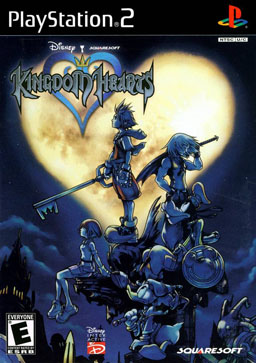
The game that started it all.

Following Kingdom Hearts 2’s release in 2005, I immediately began anticipating the third (and supposedly final) game in the series. The sequel had improved significantly on the original. It took the gameplay of the first and added more to that basic foundation. The worlds were more interesting, combat was more interactive, and great new characters were added to the cast, such as Roxas and Axel. Seeing how much Kingdom Hearts 2 had improved on the original, I couldn’t wait to see what Kingdom Hearts 3 would be.

And then I heard…nothing. For years. Eventually, I started joking that Kingdom Hearts 3 was vaporware that would never see the light of day. When information about the game finally started to trickle out, I approached it cautiously. No game can live up to a 14-year wait. Because of this, I avoided as much information about the game as possible before its release date, and tried to go in blind. My expectations weren’t excessive, by any means. I merely wanted to see the conclusion to a beloved series from my childhood. Yet even with those tempered expectations, the game falls short of what past games had achieved.
Kingdom Hearts II (PS2).jpg
Past games like Kingdom Hearts 2

From a technical gameplay standpoint, Kingdom Hearts 3 is merely average. Let’s start with the combat, which forms much of the active gameplay. Most combat encounters boil down to mashing the attack button and occasionally activating the second form of your keyblade (a sword-like weapon shaped like a key, Sora's main equipment) to win. There is no depth to the combat beyond that. While Sora’s combos are cinematic and exciting at first, by the end of the game, you’ll have seen them so often that they’ll lose all of their appeal. Yet the combat isn’t outright bad, as it at least works in the context of the game.

The problem is that the fighting is entirely one-dimensional and simplistic. The only sense of variety comes from the keyblade’s form changes, but those are merely different attack patterns as you mash the attack button some more. The only sense of combat depth that the game can muster is changing your combos to be flashier. While you can mix it up and use magic or environmental attack options, none of them feels as effective as smacking the snot out of your enemies with your keyblade’s basic attack. The game’s design attempts to accommodate new gameplay options – such as the oddly-named “flowmotion” moves — but they largely feel ineffective by mid-game. The simplistic approach to combat also manifests in the difficulty of the game. During my playthrough, I never died once on the normal difficulty. The game was mostly devoid of challenge as I sawed through countless waves of Heartless (the game’s primary non-boss enemies).

Image result for kingdom hearts heartless
A generation's nightmare
Most of the changes to combat in Kingdom Hearts 3 simply don’t work as well as the creators clearly thought they would. It tries to be faster, on the whole; Sora’s running speed picks up after only a second or two running in a straight line. As a player, I can appreciate that, because less time is spent running slowly through enormous worlds. This does not translate to the combat, however, which is mostly based on spectacle rather than interaction. The game makes a good decision in giving the player the dodge roll from the outset (a change from past games). But the length of Sora’s combos makes it unrealistic to dodge mid-combat. Most enemies telegraph their attacks clearly, and I wanted to be able to dodge most of their attacks, but Sora’s moves can take several seconds for just one hit (depending on how cinematic his move is), which renders dodging totally worthless. Often it is better just to absorb the damage and get the opportunity to start the combo over again instead of being tactical. While I can see what the game designers were thinking, the combat gameplay feels mostly like a missed opportunity.

This game’s voice acting is about as uninspired as the combat system. None of the actors show any emotion, even during times of crisis. The characters are not properly expressive for the situation and never sound like they are feeling any sort of emotion. This is bizarre, because many of these voice actors had been expressive in the past. But their performances in this game sound stiff and apathetic. It’s almost like the voice actors completely forgot how to act in the 14-year gap between games.

Another complaint I have is that the worlds take much longer to complete than in past games. One of the most unique features of Kingdom Hearts games has been staging gameplay in levels largely based on Disney properties. This time around, the developers included fewer worlds than in past games, but made them significantly lengthier. At first, this doesn’t sound so bad. But the worlds would often overstay their welcome. Some took more than 90 minutes to complete. These worlds contain several boss fights that seem like they should be the end. But the world always finds some dull reason to trudge on. Some some are just complete rehashes of the movies, the most egregious offender being the world based on the movie Frozen. They recreate certain scenes shot-for-shot, just with game main characters Sora, Donald, and Goofy stumbling around in the background. I found myself wishing these worlds were over about halfway through the experience, and hoping that the next one would be more interesting.
Image result for frozen kingdom hearts 3
For example...
In addition to being too long, the worlds are somewhat creatively limited. They’re all based on relatively recent Disney films, despite Disney’s vast catalog. The oldest film to receive a world in this game is Hercules (which came out in 1997), and that’s the first world. After that, it focuses on recent releases, such as Frozen and Tangled. I missed the chance to explore classic worlds like Neverland, Monstro, or even Timeless River from past games. Because of this recency bias, Kingdom Hearts 3 feels less strongly connected with Disney’s history than past games were. In fact, by featuring only recent Disney releases, and making several of those worlds mere recreations of the movies themselves, the game often seems like it’s merely a way to promote DVD sales.

Every complaint I have about Kingdom Hearts 3 pales in comparison to the worst offense of them all, though: the plot. The plot is incomprehensible garbage to everyone except for the people who wrote the series. To gain even a basic understanding of it requires immense effort from the player. You would have to buy numerous consoles just for Kingdom Hearts games, costing not only thousands of dollars, but also hundreds of hours. The developers initially envisioned Kingdom Hearts as a trilogy, but they stretched that out over nine games, and only added more depth and complexity to an already confusing plot. (Most confusing of all: How there can be nine games, yet the ninth is somehow only considered the third. Don’t ask.) Kingdom Hearts 3 doubles down on this convoluted story, expecting the player to have followed the releases as it frantically tries to wrap up the numerous plot threads (or at least those it decided not to retcon).
Image result for kingdom hearts 3 roxas and ventus
For example: These two, who are not one person dressed differently, or twins, or brothers, but two completely different characters.
When the story was confusing in past entries, it could at least fall back on the basic concept that Sora had set out on an adventure with his two closest friends and had been separated from them. That’s an almost universally relatable concept, and served as Sora’s primary motivation. The past games always did a great job of conveying that. Kingdom Hearts 3, however, is so busy trying to tie up loose ends that it never has time to dwell on Sora’s relationship with his friends. Riku, who had been one of Sora’s aforementioned long lost friends, actually plays a significant role for the entire story in this game. But you would never know that he and Sora are great friends unless you’ve played past games. Sora interacts with Riku the same way he would with a wet piece of cardboard. Their interactions are dull and lifeless, and there are no signs of a bond between the characters as they meet in passing between missions. To a newcomer, Riku would just be another character who for some reason pals with King Mickey--yes, Mickey Mouse is in this game; again, don’t ask--and always hangs out in the realm of darkness.

The poor writing is not limited to just Sora’s interactions with Riku, either. Sora as a character seems to be written in an entirely different fashion for Kingdom Hearts 3. In past games, he had his own personality. Sure, he could be cheesy, but he was also charming and likeable. In this game, he is--there is no better word for it--lame, and his character has very little depth. Most of his dialogue is stupid, and not in a funny or endearing way. Many of the unique aspects of his personality have been removed entirely. The majority of Sora’s character is just him getting depressed when villains tell him he isn’t good enough, only for him to be cheered up immediately by some encouraging words from Donald or Goofy. Then everything goes back to normal until they encounter another villain.
Image result for roxas eating ice cream
And they barely get to eat any ice cream. 
Here I must address something that will make absolutely no sense to someone who has never played a Kingdom Hearts game, and has now begun even to make less sense to me: the game’s use of the heart. Hearts (sort of magical stand-ins for the soul), darkness, light, and friendship feature heavily in the Kingdom Hearts series. But now that I have played Kingdom Hearts 3, I’m not entirely sure what a heart is anymore. The game gives the heart so many abilities that it can overwhelm uninitiated players. At times, it can feel like the catch-all solution for the writers, as players encounter situations such as hearts living inside of other hearts and awakening at just the right time. The game gives so much power to the heart without properly explaining what that entails or what the boundaries are for hearts that it had lost me entirely by the end. I began to write off plot points I didn’t understand as, “That was his heart doing... something.”

Kingdom Hearts 3 also completely eliminates Final Fantasy characters from the game, despite their presence in prior games (Kingdom Hearts began as a sort of Disney/Final Fantasy hybrid). The game’s director said this was intentional, as he felt that the game’s characters could stand on their own now and didn’t need support from Final Fantasy characters. The problem with this is that those Final Fantasy characters are still part of the story, and the game is still lacking in certain areas without them. I enjoyed learning more about the keyblade from Leon and Yuffie in Kingdom Hearts 1. I enjoyed battling Sephiroth and talking to Cloud in both Kingdom Hearts 1 and 2. All of this (and more) is gone in this game. While the game’s director may have felt that his characters didn’t need support from Final Fantasy characters, eliminating several important cast members makes the game feel emptier.

Image result for kingdom hearts sephiroth
To be fair, what game wouldn't feel emptier without this guy? 
Despite all of my criticisms, I must admit that Kingdom Hearts 3 did begin to redeem itself as I approached the end, the source of most of the good things I can say about it. The final world is the game’s high point. It felt good to finally fight many of the members of Organization XIII (one main group of antagonists) that had been taunting me throughout the game. The fights come in a boss-rush mode of sorts, a greater challenge than the rest of the game. You also get to team up with a variety of new characters. While fighting alongside Donald and Goofy isn’t bad, I enjoyed the variety, as I could interact further with some of the characters that I wanted to hear more from. There were even a few fleeting moments when the game began to evoke that familiar sense of connection I had with these characters in past games.

Another high point in Kingdom Hearts 3 is the music. The entire series has always had phenomenal music, and this game is no exception. The game opens with a beautiful new remix of “Dearly Beloved” and it never stops from there. Once again, the music truly shines at the end of the game, when Sora finally gets to the worlds that are unique to Kingdom Hearts 3. These original compositions are among the best in the series. Many of the songs will burrow themselves into your skull, and you’ll be looking them up on YouTube months after you’ve finished playing the game. 
As I look back on Kingdom Hearts 3, I almost feel like an angry father saying, “I’m not mad, just disappointed.” The game had potential to be great, but much of that potential was wasted on an incomprehensible plot and Disney fan service. Kingdom Hearts 1 and 2 had a different feel from the third. There isn’t one significant issue that I can point to and say, “This is why Kingdom Hearts 3 pales in comparison.” Instead, it’s a series of seemingly minor decisions that add up to a cumulatively worse game. While some may enjoy this game, I found it to be bland and lacking personality. If I had not played the past games in the series as a child, I don’t think I would have even finished it. Simply put, Kingdom Hearts 3 is average at best. And--much as it pains me to say--there are much better RPGs available elsewhere.

4/10

Friday, November 30, 2018

My Triple 10k Autumn


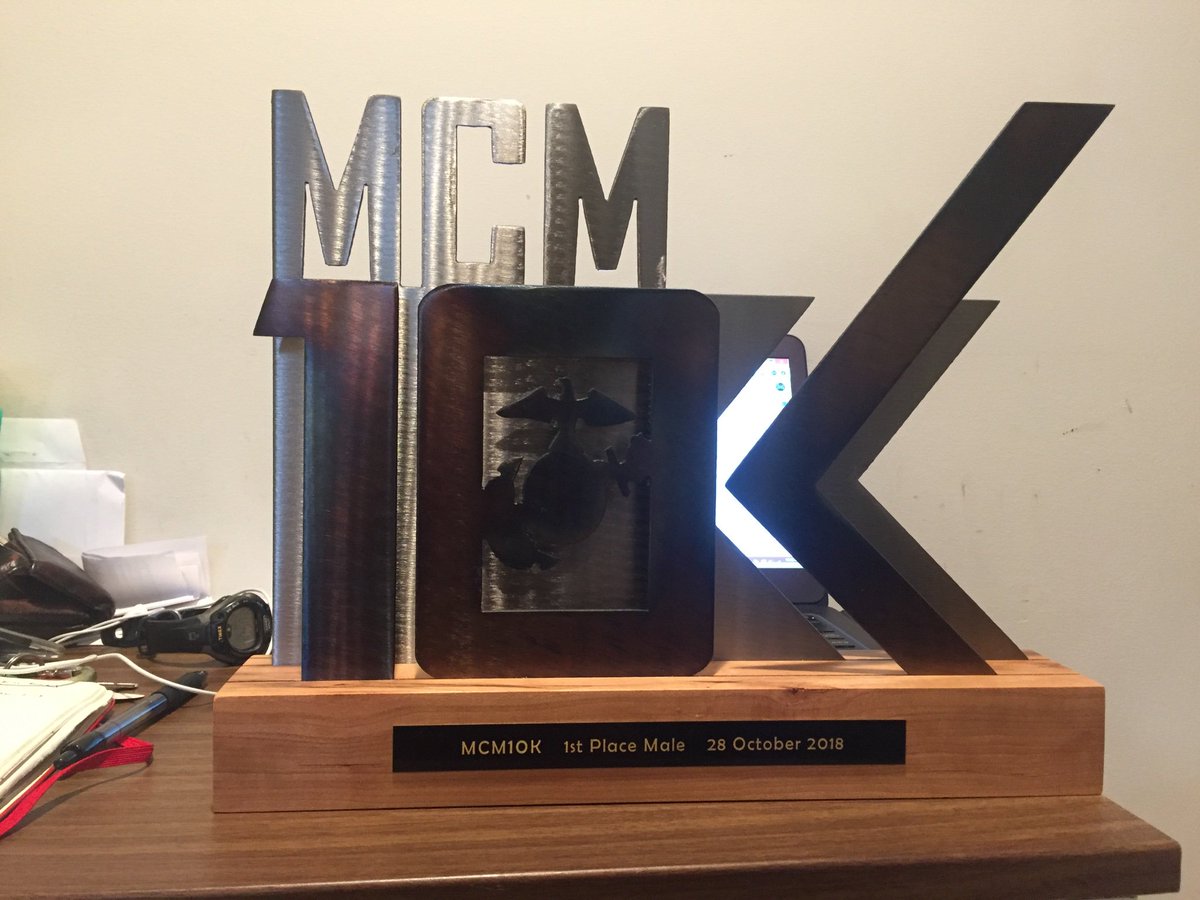
Trophy from winning the MCM 10k, which began my triple 10k autumn. Yes, I probably could kill someone with it

One of the strangest things about trying to be a serious runner solo is making my own "season." For every year of my life between 2006 and 2014, fall was a schedule of races I had nothing to do with; I just had to show up at them (and often I was driven there!).

But as a now 25-year-old post-collegiate in denial, I get to make up my own schedule. And after spending winter-spring 2017 training for a half-marathon, summer-fall 2017 training for a marathon, and winter-spring 2018 training for a half-marathon, I decided I wanted to drop down to lower distances again, especially with another marathon--Boston 2019--looming. Ideally, I might even PR in some of them. So this fall, I signed up first for a 5-miler and a 5k in September.

Looking at my October-November, though, I made a bold, potentially risky decision: I would run 3 10ks, that old collegiate staple, culminating in the Cincinnati Thanksgiving Day Race, which I have run every year since 2014. Yet describing the races as being in the October-November corridor is a bit misleading, as they were actually even more proximate: October 28, November 11, and November 22. This is a level of race proximity rigor I arguably never even reached in college. How did it go for me? Pretty well, I'd say. Herewith a summary of each race.

1) October 28: Marine Corps 10k (results)


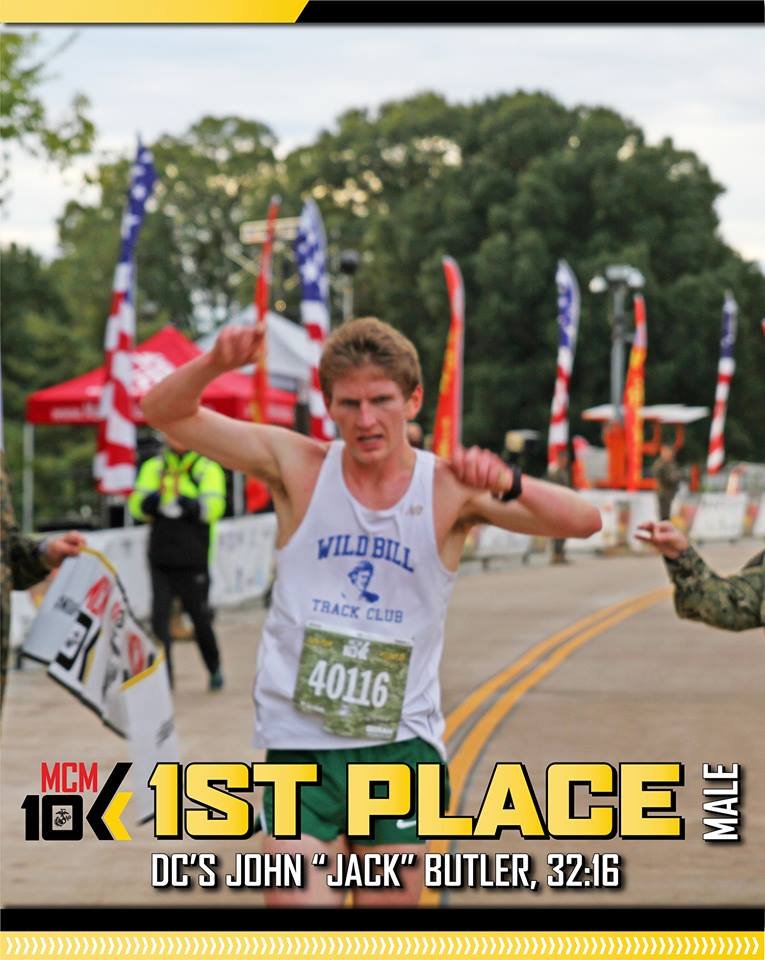
Why do race winners instinctively raise their arms as they win?
Followers of my running career may recall that I ran the Marine Corps Marathon last fall, coming in 15th with a 2:34:29 in my marathon debut (full summary here). But since I dedicated this fall to shorter races, I signed up for the Marine Corps 10k on the same day as the marathon instead. The Marine Corps 10k consists of the last 10k of the Marine Corps Marathon--i.e., the worst part of the race. But I had looked up past winning times of the race and discovered that winning it was very realistic for me. I started the race with someone running alongside me, leading me to think I might have some competition. This eventual 2nd place finisher faded by about 5k, however, and I ran all the way to a 1st place finish of 32:16 by myself. While this was not my fastest 10k time (far from it, in fact), I did run the race entirely alone after 5k, on a fairly rough course, a few days after recovering from some kind of illness. It also resulted in this post-race interview. And I later learned that I ran the second-fastest ever time for the race. So I was happy with it.

2) November 11: Veterans' Day 10k (results)


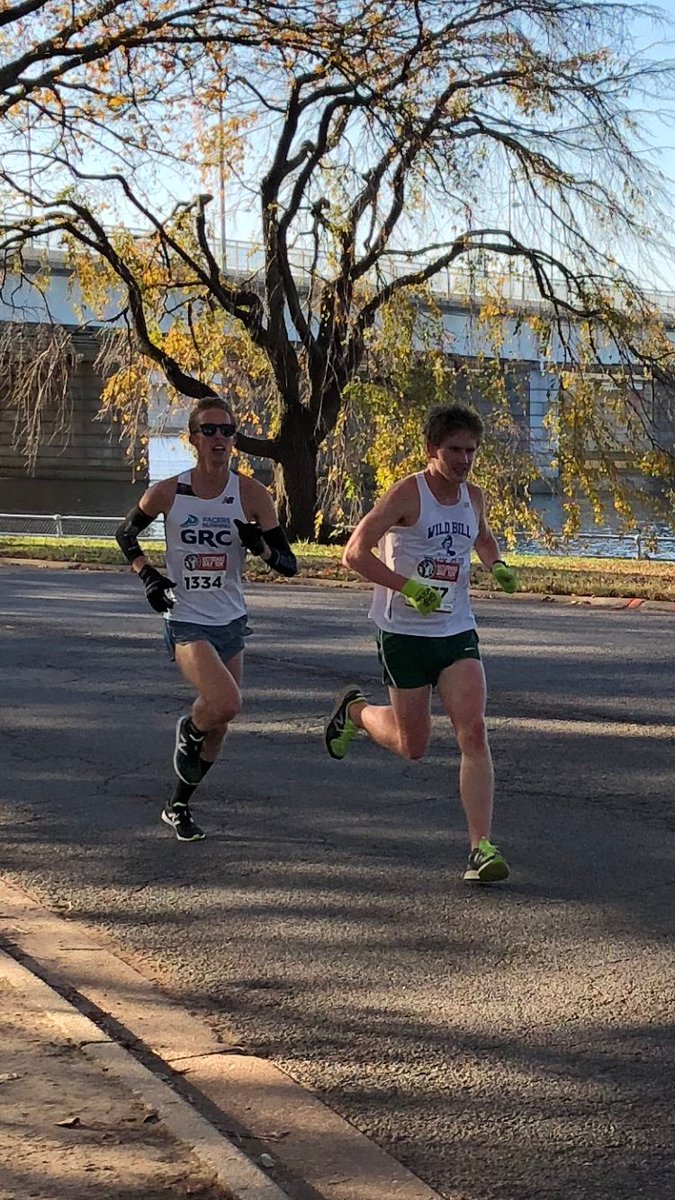
Finishing the Veterans' Day 10k alongside Kyle Wagener, who would beat me by about 9 seconds with actual speed
I chose this race instead of the Fidelity Run for the Parks 10k, held on the same course a week earlier, because I had run that race before, and because 2017's results for it and this race suggested this one would be more competitive. I had modest hopes for this race: to go sub-32, and to get in the top 5. For while I could qualify away my result for the first 10k I did this fall all I wanted, I could not deny the time itself. When this race began, I put myself in the lead pack, and was surprised to find us going sub-5 to start. And then even more surprised to find us go sub-5 again. And again. 4 miles of this race at the lead pack were sub-5, and the last two were only barely over. I faded slightly after 4 miles that fast, but chose about halfway through the next mile not to die. I ended up in 3rd place, less than 10 seconds from 1st, and 2 seconds from 2nd, both of whom outkicked me. My time of 31:03, however, was more than enough consolation. This was a lifetime 10k PR for me by more than 20 seconds, and more than 30 seconds faster than the time I ran at this course in 2016, my previous post-collegiate PR. My only regret about this race is that I lacked a stronger kick that could have gotten me sub-31, but I guess I need something to keep me motivated.

3) Cincinnati Thanksgiving Day Race (results) 


One of the few pictures from the race in which I don't look to be in pain (wearing the St.X singlet since I'm racing local)
I have run this race every year since 2014, in various states of shape: In 2014, at or near peak college shape, I was 4th in a 31:46; in 2016, having been forced by injury to take two of the three days preceding the race off of running, I was 2nd in 32:16; in 2017, less than a month after my first marathon, I was 4th in a 33:07.* This time around, though, I was in arguably better shape than I ever had been, tapered well, and managed to avoid any last-minute mishaps that had marred previous seasons. So I thought I would be capable of challenging this race's 2-time consecutive champion. Alas, it was not meant to be; he is just too good. But I still managed 2nd place in 31:44, 2 seconds faster than my collegiate peak time at this same course. I didn't feel quite at 100 percent at this race, for some reasons beyond my control and some that were, and that makes the result ever-so-slightly disappointing, as I thought I was faster than this. I am still content with it, however, especially as a way to end a pretty rigorous "season" of 10ks.

So, there you have it: My Triple 10k Autumn. As I said, I don't think I ever did something this rigorous in college. And I managed to beat my college 10k PR, something I wasn't sure I would ever do. I also proved to myself and to anyone who doubted me that I can be "fast" if I want to be; despite more than a year-and-a-half of running half-marathons and a marathon, I can still drop down for a quick and dirty 10k if I so desire. Now that I have done this, though, it's time to abandon speed for endurance once more, as I gear up for my Boston Marathon debut in spring 2019. I will most certainly write about that here when it happens, so please stay tuned for future updates on my life between runs.

Wednesday, November 28, 2018

What if 'The White Album' had been one album? A 50th anniversary inquiry

File:TheBeatles68LP.jpg
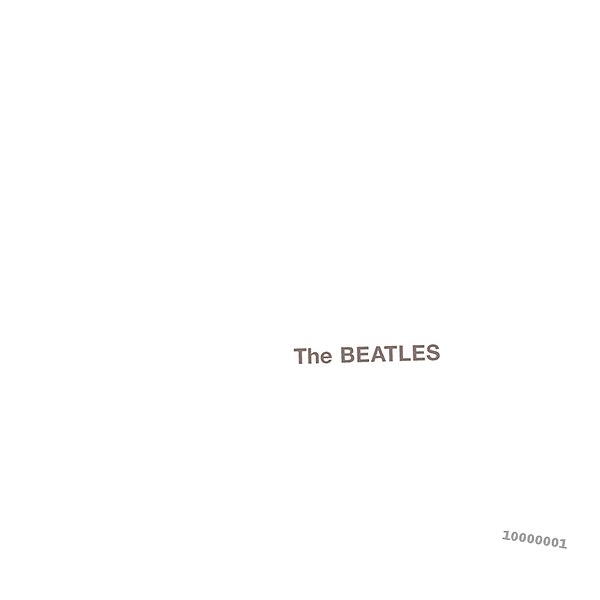
As you can see, The White Album is white. 

Last Thursday was the 50th anniversary of The Beatles, a.k.a., The White Album, The Beatles' sprawling 1968 double-LP. I took the occasion to record a podcast on The Beatles' musical legacy, which you can listen to here (also embedded below).


For other Beatles content I have produced, see my ode to George Martin, my partial encomium to Yellow Submarine, my case for the Beatles-inspired ELO to be inducted into the Rock 'n' Roll Hall of Fame (which they were after I wrote my article, proving the extent of my reach), and my analysis of Princess Leia's Stolen Death Star Plans, a rewrite of Sgt. Pepper's Lonely Hearts Club Band that makes it tell the story of Star Wars: Episode IV - A New Hope.

And speaking of The White Album and George Martin: Martin, who made so much of The Beatles' music possible, has said that The White Album should have been one album. Since then, it has become a little parlor game among Beatles' fans to decide which songs to keep to make it a perfect record. Well, I gave it a try for myself. My method here was to remove songs I didn't like, without changing the order, until I got to approximate album length for each side of the hypothetical LP.*

1. "Back in the U.S.S.R." McCartney 2:43
2. "Dear Prudence" Lennon 3:56
3. “Glass Onion" Lennon 2:18
4. "Ob-La-Di, Ob-La-Da" McCartney 3:08
5. "While My Guitar Gently Weeps" Harrison 4:45
6. "Happiness Is a Warm Gun" Lennon 2:43
7. "Blackbird" McCartney 2:18

SIDE TWO (22:46)

8. "Rocky Raccoon" McCartney 3:33
9. "Yer Blues" Lennon 4:01
10. "Sexy Sadie" Lennon 3:15
11.  "Helter Skelter" McCartney 4:29
12.  "Revolution” Lennon 4:15
13.  “Good Night” Starr 3:13

TOTAL LENGTH: 44:37
SGT. PEPPER’S LENGTH: 39:52
ABBEY ROAD LENGTH: 47: 23**

And now, to justify my decisions, first for the songs I kept. I did this in a completely arbitrary, subjective fashion, made even more so by the fact that I have no real musical training. First, here's why I kept the songs I kept:

"Back in the U.S.S.R."
In true Beatles fashion, this is a fantastic album opener. But it's also a foray into surf rock, and a parody of the Beach Boys using the imagery and vocabulary of the Soviet Union. I wouldn't dare to get rid of it.
"Dear Prudence"
"Back in the U.S.S.R." segues into this song, so I wouldn't want to get rid of it for that reason alone. But it's also a beautiful, relaxing number that climaxes beautifully, thanks to some drumming by not-Ringo.
“Glass Onion"
Some might argue that this song is The Beatles at their most self-indulgent, referencing their own songs and teasing those who try to find deeper meaning from them. But The Beatles have always been a bit cheeky, and that cheekiness is an indelible part of their appeal. Plus they'd earned a little meta by this point.
"Ob-La-Di, Ob-La-Da"
I am not a huge fan of this song, but I just love that The Beatles decided to do some reggae rock in 1968 because they felt like it. So it stays.
"While My Guitar Gently Weeps"
One of George Harrison's best career compositions (not simply as a Beatle), and one of The Beatles' best songs, period, Harrison's heartfelt lyrics and anguished delivery secure it a spot on the perfect White Album. And Eric Clapton's guitar work seals the deal.
"Happiness Is a Warm Gun"
In a little more than two-and-half minutes, John takes us through basically three different songs, all musically unique yet somehow not disjoint, with some pretty strong (i.e., blatant) sexual and drug-related symbolism to boot.
"Blackbird"
Closing side 1 with Paul's simple and comforting acoustic number to come down from the orgasmic euphoria of "Happiness Is A Warm Gun" is a nice consequence of this arrangement, but "Blackbird" could follow any song on any album and I'd keep it regardless.
"Rocky Raccoon"
Maintaining continuity with Side 1 by opening Side 2 with "Rocky Raccoon," another acoustic animal-themed number, is another happy consequence of this arrangement. But again, I would keep this song regardless of the order. Paul does a convincing Bob Dylan parody that also has something of a moral to it. Yes please.
"Yer Blues"
By the late 60s, blues had become the province of many leading rock bands. The Beatles were well aware of this, and so they decided to make light of it somewhat...while also doing it better than virtually everyone else. John's screams of "Yes I'm lonely...want to die..." are mocking the relentless blues sadness...but also seem somewhat credible coming from a soul as dark as his. That and mean guitar keep this on the album.
"Sexy Sadie"
John's thinly disguised attack on Maharashi also stays on the album for being so darn catchy, and for "inspiring" Jet's "What Have You Done" and Radiohead's "Karma Police."
"Helter Skelter"
The birth of heavy metal simply has to stay. The Beatles never got heavier than this, and even later metal bands had to try pretty hard to get here. Yes, Charles Manson later appropriated it into his bizarre fever dream apocalypse, but that wasn't The Beatles' fault.
 "Revolution”
In the late 60s, as bands became openly political (if they didn't start there), one of the only explicitly political messages in The Beatles' music was anti-revolution: "If you go carryin' pictures of Chairman Mao/You ain't gonna make it with anyone anyhow..."; "If you're talking about destruction/don't you know that you can count me out..." But there was always that extra "in..."
“Good Night”
I don't just keep this here because Ringo needs a track on the album (though he does). I genuinely enjoy this over-orchestrated, Disney-esque track, with Ringo's calmly sung lullaby vocals (ending with spoken word). Even a halved White Album takes us to some pretty wild places, so something this comforting is a good way to end.

And now to justify what I removed (again, I do this in a completely arbitrary, subjective fashion, made even more so by the fact that I have no real musical training):

"Wild Honey Pie"
I don't need to justify this. This song never should have made it out of studio diddling. 
"The Continuing Story of Bungalow Bill"
I hate the refrain of this song, I hate the structure of the verses, I don't care about the story it tells, I hate that it's the answer to the Beatles' trivia question "What Beatles' song has a vocal from a non-member?" and I hate that that non-member is Yoko Ono. 
"Martha, My Dear"
I like much of what John mockingly called Paul's "granny music," so it was a difficult choice for me to excise this. But it's not even the best granny song on the album..and it's about a dog. Dogs are great, but this is The White Album. We've got more important things to talk about. 
"I’m So Tired"
John did the "I like to sleep" thing better on Revolver's "I'm Only Sleeping," which has backwards guitar and other interesting things to commend it. This just seems like another anonymous White Album track to me. 
"Piggies"
I have a soft spot in my heart for this song, which is so delightfully weird that I do like listening to it. But it's not novel enough in its weirdness to merit inclusion. Plus, I gave "Helter Skelter" a Manson pass, but I'm not sure this gets one, as its lyrics were written in blood on the wall of a Manson murder house. 
"Don’t Pass Me By"
As far as Ringo county ditties go, I guess it's better than "Act Naturally" and "What Goes On," but that's about all I can say about it. 
"Why Don’t We Do It In The Road?" 
A fun title and rousing delivery, but beyond that, forgettable and unnecessary for a pared down White Album. 
"I Will"
This is one of several songs on The White Album so similar to each other that I always forget about them or can't distinguish them from one another in my memory: slow, acoustic, simple lyrics...whatever. Get rid of it. 
"Julia"
See above. 
"Birthday"
This song should only be listened to on your birthday. 
"Mother Nature’s Son"
This was a bit of a harder choice, as I like its structure, but it gets cut because I don't think it's really about anything. 
"Long, Long, Long"
See answer for "Julia," "I Will." 
"Everybody’s Got Something To Hide Except For Me and My Monkey"
See answer for "Why Don't We Do It In the Road." 
"Honey Pie"
Perhaps the hardest thing to cut. By far Paul's best "granny music," and a full-on Beatles music hall impression. If I could put one more song on the Half Album, this would be it. 
"Savoy Truffle" 
Another song I have a soft spot for, but a little ditty about Eric Clapton's candy addiction does not make the cut. Sorry George.
"Revolution 9" 
I don't need to justify this. How this song made it on at all when The Beatles were rejecting far-superior Harrison  compositions left and right is a mystery to me. This song should only be listened to on Halloween.   

So there you have it: My ideal White Album, with explanations for why I kept and cut what I did. To be sure, I still love The White Album as-is, and it was hard for me to criticize anything The Beatles did. I just think George Martin was right that a little bit of discipline might have helped. But The Beatles may have been beyond discipline by that point anyway, as the four stars had already begun to spiral away from each other's orbits, alas. 

Anyway, here's a Spotify playlist of The White Album with only my chosen songs: I called it "Te Wie Abm" because I removed every other letter from each word. If you like my version, then you can pretend it's the real one. Or you can make your own. Probably every Beatles' fan has a different preference. And that's one of many reasons why they're so great.

*According to this link, vinyl albums could be ~22 minutes per side: https://standardvinyl.com/vinyl-pressing/12-inch-records/
**I used this site, which I usually use to add up running splits for workouts, to add up the times.

Wednesday, October 31, 2018

Spend this Halloween at 'The Exorcist' steps

Pictured: synergy 
Longtime readers of mine--if there are any--might know about my history with the 1973 horror film with The Exorcist. Short version: For more than a decade of my life, I had nightmares about the movie--and about demonic possession more generally--after first learning about it despite never having seen it. And during Halloween 2016, I decided to face my fears and watch the movie, with the following result. As I summarized here for Acculturated (RIP):
I spent the next decade of my life blocking out any demonic pop culture—especially The Exorcist—in the hope that the fear would vanish as I aged. But it did not. My Catholic upbringing and a primal anxiety about losing control of my own body are largely to blame. The nightmares subsided, but my fright lingered. Thus, at 23 years old, I finally decided to confront my fears. I would watch The Exorcist, which was filmed in Washington, D.C., the city in which I currently work and live, for Halloween. Perhaps it would end the nightmares forever, or perhaps it would continue them indefinitely. I did not know. But so resolved, I could not back down. What I found upon watching was some of what I expected, some of what I did not, and much that made confronting my fears worthwhile.
Read the whole article I wrote for Acculturated to find my elaboration of the virtues of The Exorcist. If you don't feel like doing that, well, I'll recapitulate here: Basically, it's a wildly pro-Catholic movie about the reality of evil in the world and the importance of faith in confronting it. Owing a great deal to this, and to its genuine scares and great performances, I named The Exorcist my favorite horror movie, ranking among my all-time favorites.

Having found the experience of confronting my fears around Halloween gratifying, I decided to do the same last year, in 2017, by reading the book of the same name on which The Exorcist is based. The movie proved to be a mostly faithful adaptation of the book, with most of the few changes it made benefiting the story and not harming it.*

I started the book about a week before Halloween last year. On the evening of that Halloween, I had about 30 pages left. And then I realized something: I not only lived in the same city in which the film's famous climax takes place, but could easily access that infamous set of stairs in Georgetown (recognized as a historic landmark by D.C. on Halloween 2015, and up for national recognition). And since Halloween was a cool, pleasant night, and the area around the stairs was well-lit, I could finish the book there. As a bonus, I would get to see what it's like to be at the location of one of the most famous scenes in horror on Halloween. And so my plan for Halloween 2017 came to be.

The scary thing is that the guy walking down the stairs wasn't behind me when the picture was taken. I'm kidding (or am I?)
Reaching the steps around 6:30 pm, I found a comfortable position to sit, read, and observe. First, of course, I spent about a half-hour reading the climax of The Exorcist, during which one character takes a deadly tumble from the top of the steps down. This marked a first for me: the first time I had ever read a book at the exact location of its resolution, or perhaps any part of the book at the exact location at which it is set. As a result, I was better able to visualize precisely what I was reading better than ever before, helping the text to come alive.

But finishing the book was only the beginning of my night at the steps. Not long after arriving, I saw either a priest or someone dressed as one for Halloween approaching the steps to descend them. With the book in had, I warned him to be careful. He laughed. steady stream of hesitant tourists, of varying ages, walked by the steps and searched for some sign that they were in the right place. Showing them my copy of the book, I assured them that they were. To one of these tourists, I related a trivia fact about the book: When the filmmakers were capturing the stunt of the movie's climax (for which the stairs were covered in foam), students at Georgetown with roof views of the steps charged people to watch it from their vantage points. I volunteered to take many pictures of pairs or groups of people who came by to see the steps (one of whom reciprocated for me). Most surprising: Throughout the night, a consistent group of people were just using the steps to work out. And, finally, in the climax of my evening, at the request of one pair of horror tourists, I gave a dramatic reading of the book's dramatic resolution. I did not throw myself down the stairs at the end, but I did my best in every other respect to make it seem real. All in all, a good place to spend Halloween.

My happiness should be evidence
After leaving the steps, and in the year subsequent to my evening there, I have thought a lot about why I felt the need to go there, and why so many others did as well. The Exorcist doesn't even take place on Halloween (although at least one or two scenes seem to take place on it). So why would people go there then? To confront their fears, as I did? Because The Exorcist, as a horror movie, has become so indelibly tied up in the holiday associated with the genre? Because maybe some were hoping something might happen in that famous place on that auspicious night? Probably for all of these reasons, and more.

But whatever the reason, I highly recommend checking out The Exorcist steps this Halloween. It's a fascinating cultural experience to see who shows up there, and why. A few people may just use it to work out, but most others go to it for some ineffable, spooky, quintessentially Halloween reason(s). If you have the chance, you should join them. Just be careful not to fall down the stairs.

I hear it's happened before.

*The one exception to this might have been dropping some of the obscure references that the demon Pazuzu makes to the Bible, John Milton, C.S. Lewis, and other sources.

Friday, August 3, 2018

How my visit to an anechoic chamber changed the way I understand sound

Get you someone who looks at you the way I look at an anechoic chamber

We live in a very loud world. All around us is ambient noise: cars honking, people talking, phones ringing. One can achieve a sort of quiet by escaping to nature, yes, but even nature offers its own background sounds: birds chirping, brooks babbling, branches rustled by gusts of wind. It is hard for us to imagine what a truly soundless existence is like.

But it is no longer hard for me. For last weekend, when I was in Nashville, Tennessee, I visited the anechoic chamber at Vanderbilt University. Break down the word into its roots and you'll understand what it means: "an" - Greek: "without," (see also, anaerobic, "without air); "echo" - sound feedback, or reverberation. If that still doesn't make sense, here's a simpler explanation: An anechoic chamber is a room specially designed to eliminate the reflection and refraction of sound after its origination. In the world outside anechoic chambers, if you clap, you don't merely hear the clap: You hear the clap as it bounces off the wall, the air, the objects around you. And ditto for every other sound you make.

This is not the case in an anechoic chamber. You hear only the sound itself. The chamber "captures" the echo, killing subsequent resounding. This creates a quietude unlike virtually any we can experience in the real world. In fact, the first I heard of such a chamber was in a news story that went semi-viral a few years ago, which claimed that spending 45 minutes in such a room will drive you insane. The reason? Being in a room that quiet allows you to hear noises your own body makes that are usually inaudible, like the movement of your blood, and the functioning of your organs. It also heightens the typically feint sound of the beating heart. And, above all, it cancels out the din of existence itself, the default level of noise that we've accustomed ourselves to living today. Some people, apparently, just can't handle it.

I have been desperate to find out whether I was one of those people ever since first reading about anechoic chambers. And just before leaving last weekend on my trip to Nashville, a piece of long-forgotten information resurfaced in my brain: Somewhere in the city, there was an anechoic chamber. So I did a bit of research and discovered that the chamber was housed at Vanderbilt University. A bit more digging, and I managed to find the Vanderbilt faculty member in charge of the thing. On a lark, I sent him an email, asking if it would be possible for me to go inside while I was there, on account of my longtime interest. He said yes, and I was set.

A friend accompanied me to the chamber that day, ostensibly because he was interested as well, but perhaps also to keep me from going insane; or, failing that, to manage my insanity upon its inception. As far as I could tell, only he, myself, and the Vanderbilt faculty member who agreed to let me inside were on the floor of its location when we arrived. It was quiet on that floor--or so I thought--when the unassuming man led us to the deceptively modest door of the chamber. Just outside the room itself was a set of diodes, control panels, monitors, and other such equipment, similar in array (if not in exact function) to what one would expect outside of a recording studio. But I did not come here for that. And soon, my guide brought me into what I had come all this way for: the chamber itself.

Abandon all sound, ye who enter here 
The anechoic chamber was unlike any room I have ever been in. From the moment I entered it, and without the door to the room even being closed, the sonic landscape I perceived was completely different. The ambient buzzing of lights, the scattered scuffing of shoes on floor--all vanished, replaced with nothing except perhaps a very light ringing in my ears that could have been how my auditory organs chose to register the extreme soundlessness. The room itself was huge: its dimensions stretched both above us, surely to the next floor, and under us, surely to the floor below. Between us and the lower portion of the room was a mat of thin yet springy wire, almost like mattress springs. What I can only describe as foam spikes, always in pairs, covered all four walls of the room, pointing out at us as though at any moment I would enter an Indiana Jones movie and they would start to close in on me. In the middle of the room was a single chair, surrounded by a large metallic ring*, off of which hung a circular array of small speakers. I would never dare to say such a place had a nefarious purpose, but this setup made it look like a place where James Bond might be tortured. It also reminded me, for reasons I can't quite explain, of something out of Inception. You'll notice that I keep reaching for fictional analogues to describe this place; that is because I can find no nonfictional analogue to it in my own experience--save perhaps a recording studio, albeit one on steroids.

A narrow view
Our Vanderbilt guide explained why the room was made the way it was. It extended to the floors both above and below it to minimize the amount of sounds that could seep in from the building itself: air conditioning, the functioning of other equipment, etc. The wire floor was enough to keep us from falling below while also not being substantial enough in its own right to provide an alternative source of sound refraction. The foam spikes, arrayed in outward-facing pairs, both absorbed sound and captured it, reducing echo by forcing it into the point between the spikes until it dissipated entirely. Think of it as a sort of reverse feedback. And the single chair surrounded by speakers was its primary research manifestation. In a room so thoroughly soundproofed, researchers could build an auditory landscape from scratch. You could sit in the chair in the dark and in complete silence and have sounds issued at you from any combination of the speakers, or all of them at once. In such an environment, you could convince your ears that you were in a location of entirely different spatial dimensions from the one you actually occupied, like a giant cathedral. There were no true medicinal purposes to this room; it was for research alone. Sometimes, they even accept requests from local music acts to record in it. Manufacturers of notoriously loud objects, such as airplanes, have rooms many times its size but identical in nature so they can test the sound generation of their equipment, as basically sonic wind tunnels. There are all sorts of thing one can do with an anechoic chamber.

The chair of sound
Which may be part of why this room entranced me from the moment I entered it. And the more our guide told me, the more fascinated I became. I could already notice a difference in the sound (or lack thereof) around us when we walked in, even though he hadn't even closed the door. Once he did that, all the eerie silence of the room kicked up a notch. Just talking sounded weird. In a few moments of silence, I could hear my heart beating, my blood moving, and my stomach noisily squelching and digesting my lunch. And clapping--oh, clapping! I struggle even to describe what it sounds like to clap in such a place. It was as though my hands were made of sponge. We don't realize, outside of such a place, how much of the noise of a clap is actually its echo. But in the anechoic chamber, you realize it by its absence. Never did I think something so simple as a clap could be so mindblowing.

Yet all this was a mere prelude to the peak of my experience in the anechoic chamber. On two occasions, our Vanderbilt guide allowed me in the room alone, with the door closed, in the dark. I would soon get the answer as to whether such an environment could actually drive me insane. On the first stint, I sat in the chair, preparing myself. First, the door closed. Then, the lights went off. I closed my eyes. After only a few seconds, I felt completely weightless, like I was floating in a pool, or perhaps in space. In the essence of quiescence that I experienced, I heard nothing at all, and I began to lose spatial orientation: up, down, right, left--all of this lost its typical meaning. My thoughts quickly drifted to where they usually only go on the edge of sleep, a twilight wasteland of fragmented cogitations. I felt like I could stay there forever.

Me, in my element 
Then the lights came back on, the door opened, and our Vanderbilt guide returned me to reality. It had somehow only been a minute. But I had experienced something more powerful than my deepest sleeps. And I had an identical experience when, as we were about to leave, I begged for another time in the chamber alone. The main difference between the first and second times was that, on the second time, I felt like I could have fallen asleep almost instantly; that, in fact, I may never be able to sleep anywhere else.

Alas, my time at the anechoic chamber had come to a close. Before we left, though, I had to ask our Vanderbilt guide whether what I had heard was true: Could prolonged exposure to this environment really make people go insane? Can we sound-accustomed humans really not handle such a deprivation? He said no: Indeed, he sometimes spends consecutive hours in it alone, with only a lunchbreak, and his sanity is still fully intact. He seemed like a pretty sane fellow, so I guess I have to take him at his word, for now.

And so we left the most incredible room I have ever entered. This despite the fact that I had so much left that I still wanted to do in there. I wanted to sit in there until I heard all of my organs churning. I wanted to wait and see if I really did go insane. I wanted to take a nap, because I've never been anywhere quieter and more conducive to sleep for the light sleeper than I am. I wanted to whistle in there, which I wish I'd had the presence of mind to think of doing. And, above all, I wanted to sit in the chair, turn off the lights, and blast Pink Floyd's Dark Side of the Moon from all the speakers surrounding me and listen to the whole thing, which I think is how the band actually meant for it to be experienced. For now, these desires will have to wait until my next trip to an anechoic chamber. For rest assured, there will be another trip. I didn't even go to the one that inspired all of those viral stories; it's in Minneapolis. I will return to this kind of room while I have time left to do so. This kind of experience is not the sort of thing you only do once.

Me, laying down some sick tracks
As my friend and I left the building that housed the chamber, the sounds of the world began to creep back in: the cars, the people, the birds, the wind. But I don't think it's an exaggeration to say that they all sounded a little bit...different. If it's true that you can only truly appreciate a thing by experiencing its absence, then perhaps the chamber heightened my perception of the sounds I usually hear. It got me unused to them, if only briefly, making my reintroduction to them all the more noticeable. A week later, I don't think the experience of being in a soundless room has made me permanently unable to tolerate sound (a la Rick and Morty's "absolute level"), insane, or unable to sleep. Yet I do have some evidence it had an effect on me. As my friend and I walked around Vanderbilt's campus after leaving the chamber, I heard a light ringing on the ground. I stopped, turned around, and scanned the ground, discovering that I had kicked a penny. I joked to my friend that the fact that I had heard it and he had not meant that the anechoic chamber had improved my hearing to Daredevil-esque levels (we had joked beforehand that some bizarre mishap in the chamber would occur while I was inside that would give me sound-based superpowers). And when I picked the penny up, I noticed something strange: It was minted in the year of my birth.

Had my chamber-enhanced hearing not only allowed me to hear the penny itself, but also the slight variations in its grooves and etchings that would distinguish a penny minted in 1993 from one minted in 1992 or 1994? Who is to say? All I can say is that I must return to an anechoic chamber as soon as possible, and that I highly recommend you take a visit as well. In a loud world, they offer a quiet unlike anything you've ever experienced.

Unless, that is, you've already been in one.

*They are planning to add another ring, circling vertically, for maximum auditory landscape manipulation.