Longtime readers of mine--if there are any--might know about my history with the 1973 horror film with The Exorcist. Short version: For more than a decade of my life, I had nightmares about the movie--and about demonic possession more generally--after first learning about it despite never having seen it. And during Halloween 2016, I decided to face my fears and watch the movie, with the following result. As I summarized here for Acculturated (RIP):
I spent the next decade of my life blocking out any demonic pop culture—especially The Exorcist—in the hope that the fear would vanish as I aged. But it did not. My Catholic upbringing and a primal anxiety about losing control of my own body are largely to blame. The nightmares subsided, but my fright lingered. Thus, at 23 years old, I finally decided to confront my fears. I would watch The Exorcist, which was filmed in Washington, D.C., the city in which I currently work and live, for Halloween. Perhaps it would end the nightmares forever, or perhaps it would continue them indefinitely. I did not know. But so resolved, I could not back down. What I found upon watching was some of what I expected, some of what I did not, and much that made confronting my fears worthwhile.
Read the whole article I wrote for Acculturated to find my elaboration of the virtues of The Exorcist. If you don't feel like doing that, well, I'll recapitulate here: Basically, it's a wildly pro-Catholic movie about the reality of evil in the world and the importance of faith in confronting it. Owing a great deal to this, and to its genuine scares and great performances, I named The Exorcist my favorite horror movie, ranking among my all-time favorites.
Having found the experience of confronting my fears around Halloween gratifying, I decided to do the same last year, in 2017, by reading the book of the same name on which The Exorcist is based. The movie proved to be a mostly faithful adaptation of the book, with most of the few changes it made benefiting the story and not harming it.*
I started the book about a week before Halloween last year. On the evening of that Halloween, I had about 30 pages left. And then I realized something: I not only lived in the same city in which the film's famous climax takes place, but could easily access that infamous set of stairs in Georgetown (recognized as a historic landmark by D.C. on Halloween 2015, and up for national recognition). And since Halloween was a cool, pleasant night, and the area around the stairs was well-lit, I could finish the book there. As a bonus, I would get to see what it's like to be at the location of one of the most famous scenes in horror on Halloween. And so my plan for Halloween 2017 came to be.
The scary thing is that the guy walking down the stairs wasn't behind me when the picture was taken. I'm kidding (or am I?)
Reaching the steps around 6:30 pm, I found a comfortable position to sit, read, and observe. First, of course, I spent about a half-hour reading the climax of The Exorcist, during which one character takes a deadly tumble from the top of the steps down. This marked a first for me: the first time I had ever read a book at the exact location of its resolution, or perhaps any part of the book at the exact location at which it is set. As a result, I was better able to visualize precisely what I was reading better than ever before, helping the text to come alive.
But finishing the book was only the beginning of my night at the steps. Not long after arriving, I saw either a priest or someone dressed as one for Halloween approaching the steps to descend them. With the book in had, I warned him to be careful. He laughed. steady stream of hesitant tourists, of varying ages, walked by the steps and searched for some sign that they were in the right place. Showing them my copy of the book, I assured them that they were. To one of these tourists, I related a trivia fact about the book: When the filmmakers were capturing the stunt of the movie's climax (for which the stairs were covered in foam), students at Georgetown with roof views of the steps charged people to watch it from their vantage points. I volunteered to take many pictures of pairs or groups of people who came by to see the steps (one of whom reciprocated for me). Most surprising: Throughout the night, a consistent group of people were just using the steps to work out. And, finally, in the climax of my evening, at the request of one pair of horror tourists, I gave a dramatic reading of the book's dramatic resolution. I did not throw myself down the stairs at the end, but I did my best in every other respect to make it seem real. All in all, a good place to spend Halloween.
My happiness should be evidence
After leaving the steps, and in the year subsequent to my evening there, I have thought a lot about why I felt the need to go there, and why so many others did as well. The Exorcist doesn't even take place on Halloween (although at least one or two scenes seem to take place on it). So why would people go there then? To confront their fears, as I did? Because The Exorcist, as a horror movie, has become so indelibly tied up in the holiday associated with the genre? Because maybe some were hoping something might happen in that famous place on that auspicious night? Probably for all of these reasons, and more.
But whatever the reason, I highly recommend checking out The Exorcist steps this Halloween. It's a fascinating cultural experience to see who shows up there, and why. A few people may just use it to work out, but most others go to it for some ineffable, spooky, quintessentially Halloween reason(s). If you have the chance, you should join them. Just be careful not to fall down the stairs.
*The one exception to this might have been dropping some of the obscure references that the demon Pazuzu makes to the Bible, John Milton, C.S. Lewis, and other sources.
Get you someone who looks at you the way I look at an anechoic chamber
We live in a very loud world. All around us is ambient noise: cars honking, people talking, phones ringing. One can achieve a sort of quiet by escaping to nature, yes, but even nature offers its own background sounds: birds chirping, brooks babbling, branches rustled by gusts of wind. It is hard for us to imagine what a truly soundless existence is like.
But it is no longer hard for me. For last weekend, when I was in Nashville, Tennessee, I visited the anechoic chamber at Vanderbilt University. Break down the word into its roots and you'll understand what it means: "an" - Greek: "without," (see also, anaerobic, "without air); "echo" - sound feedback, or reverberation. If that still doesn't make sense, here's a simpler explanation: An anechoic chamber is a room specially designed to eliminate the reflection and refraction of sound after its origination. In the world outside anechoic chambers, if you clap, you don't merely hear the clap: You hear the clap as it bounces off the wall, the air, the objects around you. And ditto for every other sound you make.
This is not the case in an anechoic chamber. You hear only the sound itself. The chamber "captures" the echo, killing subsequent resounding. This creates a quietude unlike virtually any we can experience in the real world. In fact, the first I heard of such a chamber was in a news story that went semi-viral a few years ago, which claimed that spending 45 minutes in such a room will drive you insane. The reason? Being in a room that quiet allows you to hear noises your own body makes that are usually inaudible, like the movement of your blood, and the functioning of your organs. It also heightens the typically feint sound of the beating heart. And, above all, it cancels out the din of existence itself, the default level of noise that we've accustomed ourselves to living today. Some people, apparently, just can't handle it.
I have been desperate to find out whether I was one of those people ever since first reading about anechoic chambers. And just before leaving last weekend on my trip to Nashville, a piece of long-forgotten information resurfaced in my brain: Somewhere in the city, there was an anechoic chamber. So I did a bit of research and discovered that the chamber was housed at Vanderbilt University. A bit more digging, and I managed to find the Vanderbilt faculty member in charge of the thing. On a lark, I sent him an email, asking if it would be possible for me to go inside while I was there, on account of my longtime interest. He said yes, and I was set.
A friend accompanied me to the chamber that day, ostensibly because he was interested as well, but perhaps also to keep me from going insane; or, failing that, to manage my insanity upon its inception. As far as I could tell, only he, myself, and the Vanderbilt faculty member who agreed to let me inside were on the floor of its location when we arrived. It was quiet on that floor--or so I thought--when the unassuming man led us to the deceptively modest door of the chamber. Just outside the room itself was a set of diodes, control panels, monitors, and other such equipment, similar in array (if not in exact function) to what one would expect outside of a recording studio. But I did not come here for that. And soon, my guide brought me into what I had come all this way for: the chamber itself.
Abandon all sound, ye who enter here
The anechoic chamber was unlike any room I have ever been in. From the moment I entered it, and without the door to the room even being closed, the sonic landscape I perceived was completely different. The ambient buzzing of lights, the scattered scuffing of shoes on floor--all vanished, replaced with nothing except perhaps a very light ringing in my ears that could have been how my auditory organs chose to register the extreme soundlessness. The room itself was huge: its dimensions stretched both above us, surely to the next floor, and under us, surely to the floor below. Between us and the lower portion of the room was a mat of thin yet springy wire, almost like mattress springs. What I can only describe as foam spikes, always in pairs, covered all four walls of the room, pointing out at us as though at any moment I would enter an Indiana Jones movie and they would start to close in on me. In the middle of the room was a single chair, surrounded by a large metallic ring*, off of which hung a circular array of small speakers. I would never dare to say such a place had a nefarious purpose, but this setup made it look like a place where James Bond might be tortured. It also reminded me, for reasons I can't quite explain, of something out of Inception. You'll notice that I keep reaching for fictional analogues to describe this place; that is because I can find no nonfictional analogue to it in my own experience--save perhaps a recording studio, albeit one on steroids.
A narrow view
Our Vanderbilt guide explained why the room was made the way it was. It extended to the floors both above and below it to minimize the amount of sounds that could seep in from the building itself: air conditioning, the functioning of other equipment, etc. The wire floor was enough to keep us from falling below while also not being substantial enough in its own right to provide an alternative source of sound refraction. The foam spikes, arrayed in outward-facing pairs, both absorbed sound and captured it, reducing echo by forcing it into the point between the spikes until it dissipated entirely. Think of it as a sort of reverse feedback. And the single chair surrounded by speakers was its primary research manifestation. In a room so thoroughly soundproofed, researchers could build an auditory landscape from scratch. You could sit in the chair in the dark and in complete silence and have sounds issued at you from any combination of the speakers, or all of them at once. In such an environment, you could convince your ears that you were in a location of entirely different spatial dimensions from the one you actually occupied, like a giant cathedral. There were no true medicinal purposes to this room; it was for research alone. Sometimes, they even accept requests from local music acts to record in it. Manufacturers of notoriously loud objects, such as airplanes, have rooms many times its size but identical in nature so they can test the sound generation of their equipment, as basically sonic wind tunnels. There are all sorts of thing one can do with an anechoic chamber.
The chair of sound
Which may be part of why this room entranced me from the moment I entered it. And the more our guide told me, the more fascinated I became. I could already notice a difference in the sound (or lack thereof) around us when we walked in, even though he hadn't even closed the door. Once he did that, all the eerie silence of the room kicked up a notch. Just talking sounded weird. In a few moments of silence, I could hear my heart beating, my blood moving, and my stomach noisily squelching and digesting my lunch. And clapping--oh, clapping! I struggle even to describe what it sounds like to clap in such a place. It was as though my hands were made of sponge. We don't realize, outside of such a place, how much of the noise of a clap is actually its echo. But in the anechoic chamber, you realize it by its absence. Never did I think something so simple as a clap could be so mindblowing.
Yet all this was a mere prelude to the peak of my experience in the anechoic chamber. On two occasions, our Vanderbilt guide allowed me in the room alone, with the door closed, in the dark. I would soon get the answer as to whether such an environment could actually drive me insane. On the first stint, I sat in the chair, preparing myself. First, the door closed. Then, the lights went off. I closed my eyes. After only a few seconds, I felt completely weightless, like I was floating in a pool, or perhaps in space. In the essence of quiescence that I experienced, I heard nothing at all, and I began to lose spatial orientation: up, down, right, left--all of this lost its typical meaning. My thoughts quickly drifted to where they usually only go on the edge of sleep, a twilight wasteland of fragmented cogitations. I felt like I could stay there forever.
Me, in my element
Then the lights came back on, the door opened, and our Vanderbilt guide returned me to reality. It had somehow only been a minute. But I had experienced something more powerful than my deepest sleeps. And I had an identical experience when, as we were about to leave, I begged for another time in the chamber alone. The main difference between the first and second times was that, on the second time, I felt like I could have fallen asleep almost instantly; that, in fact, I may never be able to sleep anywhere else.
Alas, my time at the anechoic chamber had come to a close. Before we left, though, I had to ask our Vanderbilt guide whether what I had heard was true: Could prolonged exposure to this environment really make people go insane? Can we sound-accustomed humans really not handle such a deprivation? He said no: Indeed, he sometimes spends consecutive hours in it alone, with only a lunchbreak, and his sanity is still fully intact. He seemed like a pretty sane fellow, so I guess I have to take him at his word, for now.
And so we left the most incredible room I have ever entered. This despite the fact that I had so much left that I still wanted to do in there. I wanted to sit in there until I heard all of my organs churning. I wanted to wait and see if I really did go insane. I wanted to take a nap, because I've never been anywhere quieter and more conducive to sleep for the light sleeper than I am. I wanted to whistle in there, which I wish I'd had the presence of mind to think of doing. And, above all, I wanted to sit in the chair, turn off the lights, and blast Pink Floyd's Dark Side of the Moon from all the speakers surrounding me and listen to the whole thing, which I think is how the band actually meant for it to be experienced. For now, these desires will have to wait until my next trip to an anechoic chamber. For rest assured, there will be another trip. I didn't even go to the one that inspired all of those viral stories; it's in Minneapolis. I will return to this kind of room while I have time left to do so. This kind of experience is not the sort of thing you only do once.
Me, laying down some sick tracks
As my friend and I left the building that housed the chamber, the sounds of the world began to creep back in: the cars, the people, the birds, the wind. But I don't think it's an exaggeration to say that they all sounded a little bit...different. If it's true that you can only truly appreciate a thing by experiencing its absence, then perhaps the chamber heightened my perception of the sounds I usually hear. It got me unused to them, if only briefly, making my reintroduction to them all the more noticeable. A week later, I don't think the experience of being in a soundless room has made me permanently unable to tolerate sound (a la Rick and Morty's "absolute level"), insane, or unable to sleep. Yet I do have some evidence it had an effect on me. As my friend and I walked around Vanderbilt's campus after leaving the chamber, I heard a light ringing on the ground. I stopped, turned around, and scanned the ground, discovering that I had kicked a penny. I joked to my friend that the fact that I had heard it and he had not meant that the anechoic chamber had improved my hearing to Daredevil-esque levels (we had joked beforehand that some bizarre mishap in the chamber would occur while I was inside that would give me sound-based superpowers). And when I picked the penny up, I noticed something strange: It was minted in the year of my birth.
Had my chamber-enhanced hearing not only allowed me to hear the penny itself, but also the slight variations in its grooves and etchings that would distinguish a penny minted in 1993 from one minted in 1992 or 1994? Who is to say? All I can say is that I must return to an anechoic chamber as soon as possible, and that I highly recommend you take a visit as well. In a loud world, they offer a quiet unlike anything you've ever experienced.
Unless, that is, you've already been in one.
*They are planning to add another ring, circling vertically, for maximum auditory landscape manipulation.
Readers of this blog, if there are any left, will know that I am prone to (excessive?) reflection, retrospection, and nostalgia, and obsessed with anniversaries. 10-year anniversaries seem particularly potent reflection-inducers for me, perhaps because as a relatively young person, I'm still weirded out by by the fact that I am now able to start thinking of my life in terms of decades.
So all week I've been thinking about a trip I took to D.C. in 2008, exactly 10 years ago. It was my first time in the city. I went with my father, and we went to all the sights: the Mall, the Washington Monument, the Lincoln and Jefferson Memorials, the National Archives, Capitol Hill, the Supreme Court, the White House (we got tours of both, thanks to Bush administration connections), Georgteown, Arlington Cemetery, Mt. Vernon, and perhaps other D.C.-area things I'm forgetting.*
We also went to Annapolis to visit the Naval Academy, back when I thought I might be interested in that kind of thing. On the way back, we stopped at a theater (my father thinks it was this one) and saw The Dark Knight on opening day, which became important to me later for other reasons.
At the time, I had a vague interest in politics, stimulated by the ongoing election, which was only about to get weirder; the financial crisis of fall 2008 was still a few weeks away, though the price of oil reached an all-time high the week we were there. I didn't fully understand the world of politics, but was on the cusp of starting to. I didn't think I necessarily wanted to go into politics (whatever that means), though the 2008 election would ultimately help to change that. At the time, this was just a fun trip with my Dad.
But 10 years later, I live here. The sights I saw then I walk or run by almost every day; they haven't gone anywhere, and I know exactly where they all are, which makes it a lot easier than usual to place my nostalgia in context. It's also very easy to return to the exact same places. I mean, I live on Capitol Hill. It turns out this trip was more important than I could have possibly realized. It set in motion and prepared me for the next 10 years of my life, three of which I have now spent in D.C., with long stints during two others. That fact offers me more to ponder than the typical ruminations inspired by the mere passage of time. Among other things, it makes me wonder: What am I doing now that might actually be foreshadowing my future?
Obviously, right now I don't know. But I guess I'll find out with another ten years gone.
*But one thing I'll certainly never forget is getting rained on while walking by the Korean War memorial, and seeing the bronze soldiers there as they are meant to be seen: walking through the rain themselves.
As I turn 25, I find myself thinking about music, as I often am. From the references to the age of 25 in music, one gets the sense that is the youngest age that passes for genuinely "adult." There's David Bowie's Mott the Hoople's glam-rock anthem, in which the singer describes the plans of a "Billy":
Billy rapped all night about his suicide
How he'd kick it in the head when he was twenty-five
Don't wanna stay alive when you're twenty-five
Much like Roger Daltrey singing in "My Generation," Billy, presumably younger than 25, can't possibly imagine living to be 25. That's, like, so old, dude.
Then there's Sugar Ray's "Fly," a song that often came on the radio of my neighborhood pool when I was growing up. It's a light, catchy, reggae-influenced pop hit...that has this random line: "Twenty-five years old, my mother God rest her soul."
I've been hearing this song for almost 20 years, and I've never understood why this line was in it. I think I know what it's supposed to mean; the singer's mother died at 25, obviously. 25: Just old enough to have done something with your life (in this case, have a child), but still young enough for a life ending then to be tragic.
Finally, there's "Graduation (Friends Forever)" by Vitamin C. Another song I remember from my pool years (if somewhat more vaguely), this song imagines the experience of graduating high school from the heady haze of its aura of completion:
And so we talked all night about the rest of our lives
Where we're gonna be when we turn twenty five
I keep thinking times will never change
Keep on thinking things will always be the same
Like "All the Young Dudes," (which it references), "Graduation" imagines 25 as a far-off age, one close enough to conceptualize and understand, but distant enough to be intimidating and incredible.
Now, you may be saying I've just picked three random songs that all happen to mention the age of 25. And you'd be right! I do think, however, that they all get at something about being 25: It's an age that seems old when you're young. But now that I am 25...it feels basically the same as every age I've been since I turned 21 (especially physically; I'm basically in the same shape I've been since then). I remain in the wasteland of my ambiguous 20s.
But there is actually significance to 25 that I'm not making up just because today is my 25th birthday and I want to write about it. For today, I depart from a very special category: the 18-24-year-old demographic. Common in polls, ratings, and entertainment, the 18-24-year-old parameter is perhaps the key determinant of what these entities think a young person with money of his or her own to spend is and does. If you want to know what "the youth" are up to, you try to figure out what 18-24-year-olds are into.
As of today, that is no longer me. My opinion is no longer representative of that of a demographically "young" person (although I don't think it was, or ever has been, but that's a different matter). So what did I do in my last year of demographic, representative youth? Some decidedly non-representative things, if I do say so myself (and I will). In keeping with the trend I began last year, herewith I present, for my own indulgence and (I hope) for your edification, a summary of the highlights of my year as a 24-year-old.
-In August, after settling into my new apartment, I decided to become a cross-country coach for my local parish's grade school team. At the same time, while training for the Marine Corps Marathon, I finally ran a 100-mile week (actually 105 miles), something I came less than one mile short of doing in college.
Pictured: Not peaking in college
-In September, I entered the Navy/Air Force Half Marathon, hoping to use it as a long tempo workout. Instead, I ran what was then a PR in that distance (1:12:42, beating my Flying Pig Time from the previous May), finishing 9th.
Later that month, on Halloween, I spent the evening on The Exorcist steps, where I finished reading the book at the location of its climax while conversing with locals and tourists who stopped by on that rather propitious night. I provided trivia, dramatic readings, pictures, and a warning to one fellow who walked down the steps who was either a priest or dressed like one.
The best place to be on Halloween.
-In November, I visited New York City for the first time, doing as much of the city as I could in the time I had there. I didn't get north of the Central Park Reservoir from Marathon Man, though I did run around it.
Being a tourist. The Statue of Liberty was smaller than I expected.
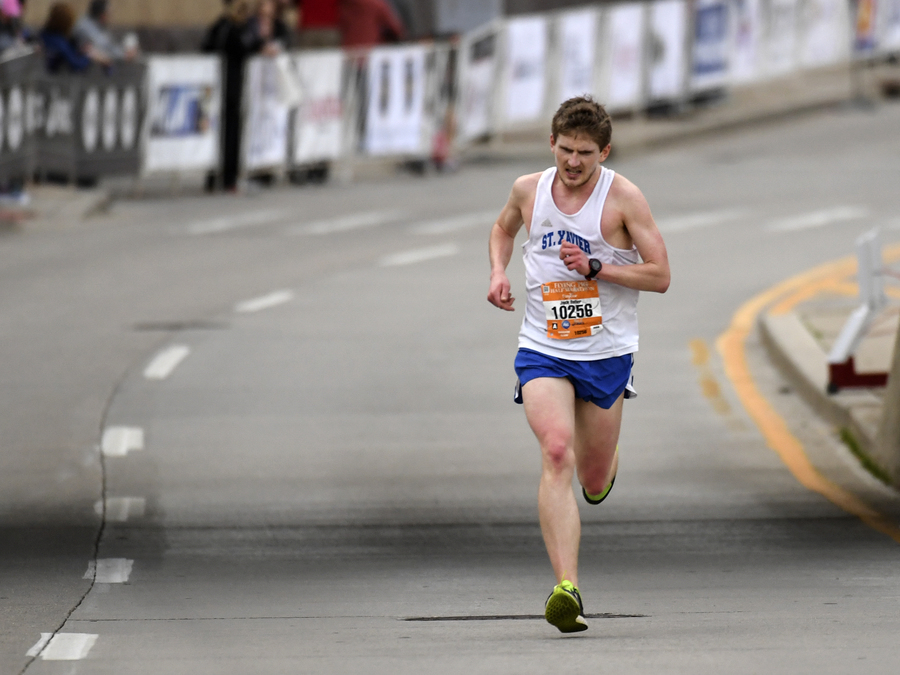
Later that month, I ran Cincinnati's Thanksgiving Day Race on very little training. After spending the first two miles running conservatively and figuring out what kind of shape I was in, I worked my way up to 4th place.
I was in third, for a bit, but I was outkicked by this guy. And not for the first time...
-In December, I returned to Cincinnati to spend Christmas with my entire family, (unexpectedly!) reunited for the holiday.
I'm the one in the middle.
I also reunited with a friend who currently lives and works with South Korea, who was back visiting for the holidays. And I ended the calendar year (a temporal interval I don't really think of my life in terms of yet) by growing a real ice beard again, for the first time since 2014.
I think this is a good look for me.
-In February, my family reunited once more, for a 60th birthday party for my parents that we siblings planned ourselves. It was a smashing success.
Family...again!
-In April, I attended Easter mass at the National Shrine of the Immaculate Conception, a beautiful church in Washington, D.C. I also ran the Cherry Blossom 10-miler, this time really as a workout, and ran 53:15, coming in 46th (out of a race well in excess of of 10,000), competing for the first time (to my knowledge) against actual Olympians. I closed out the month with the release of Suicide of the West by Jonah Goldberg, a book in whose production I greatly assisted (if you have a copy, check the acknowledgements).
-And in early July, thanks to the helpfully annoying insistence of a friend, I finished the rough draft of a novel that I had spent most of the first six months of the year writing on and off (which is why this blog was so inactive for the first half of this year), and much of the past 5 (!) years thinking about on and off. I am too coy to say more about it now, but I hope one day you all will be able to buy a copy.
So that was 24. All in all, a good year, one sufficiently replete with experiences that will allow me to distinguish it from the years already passed and the years to come. This being my standard for life post-graduation, I am content with having met it once more. I do not yet know what the quarter-century mark will bring (though I have some ideas). But if it is anything in quality or character like 23 or 24, then I think I'll be okay.
Although who cares what I think? I'm not an 18-24-year-old anymore. I just hope I'm still a young dude.
There are two things I don’t often get the chance to do in
this life: travel through time, and accomplish exactly what I set out to. The
first, obviously, is impossible—for now, anyway: Despite its fictional
popularity, no physicist or garage-tinkering amateur has yet figured out how to
transcend the limits of spacetime. You could say that the second is impossible
as well: As human beings, frustratingly finite, perpetually imperfect, we never
quite get exactly what we want. But on May 6, 2018, at the Cincinnati Flying Pig
Half Marathon, I came just about as close to doing both as I think I ever have.
How, you might wonder first, did I travel through time on this
day? Repetition. I ran this same race last year, and did okay: I was 4th
in 1:13:23, a time that I accepted then because of the difficulties that
preceded it, but which I knew I could improve upon in the future. I had not
planned to run the Flying Pig Half again this year; my original plan for 2018
was to run a half in March, and run the Flying Pig Full in May, but life
intervened. And so I came to the line of this race, almost exactly a year
later, with everything about last year’s performance fresh in my mind.
Me, during last year's performance.
But this time travel advantage did not only exist on race
day. For once I had decided to do the race again, I could take into account
certain things about the race this year that I did not know last year, from
items as basic as race-day logistics all the way up to things like strategy and
training. And perhaps the most important lesson I learned from last year’s race
was this: Be ready for the brutal hills that dominate the race’s middle miles.
Last year, I did not prepare for them adequately, and I suffered. Because of
them, the middle of the race quite nearly destroyed me, and I required a
near-miraculous comeback just to finish. But this year, knowing that the race’s
middle miles would be largely uphill, I could and did prepare for them,
incorporating hill workouts into my training for the race. I thought it
reasonable that I could at least use this foreknowledge to power myself to a
PR: sub-1:12, certainly, sub 1:11, if I was feeling bold.
And how, you might wonder next, did I accomplish exactly what I set out to do?
Well…I won. I was somewhat high on my chances of doing so before I even got to
the starting line of today’s race: I was in good shape, better shape than last
year, when I was 4th. I knew that many of my typical local
competitors would either not be racing me, or, if they were, they would not be
doing so at full strength, having just completed other races, such as the
Boston Marathon, a few weeks before. This is why I came to the starting line
with a not-unrealistic hope of victory. But victory itself still seemed a bit
lofty a goal, almost too good to be true, for one of the biggest races of the
year in my hometown. Against 13,000+ people, surely I would fall to at least
one of them? But no. I did not. I won. And now I relate the story of my
victory.
---------
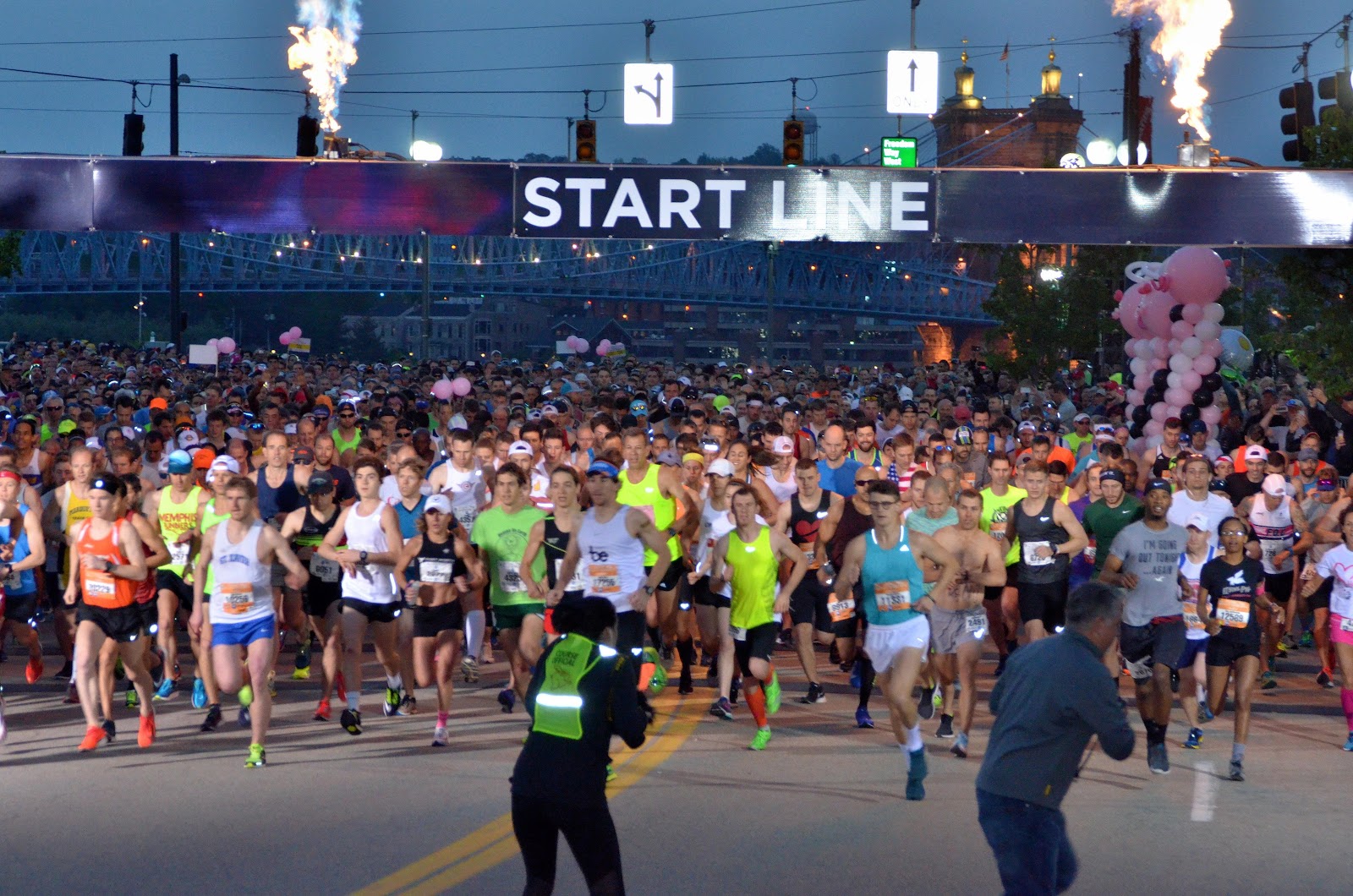
The starting line of the race. I am on the left, in the white and blue, already next to someone who would become important later.
With winning the race a realistic but by no means certain
outcome, I started it at the very front. My tentative strategy, again,
influenced by last year’s race, was to start out a little faster than I did
last year, to hold on for dear life up the hills, and then finish as fast as I
could, when the race became downhill/flat. If this meant running the race
entirely alone, then so be it; if this meant dueling one or more fellow elites,
I was fine with that as well. And not long after the starting gun went off, and
the flamethrowers atop the starting line let loose (yes, this race has starting
line flamethrowers), I discovered that I would not be alone. It only took about
800 meters, in fact, for my main competition to reveal himself. He and I
settled quickly alongside one another behind the lead vehicle, which also had a
timer, as we made our way through the early portions of the race. I checked my
watch nervously, perhaps obsessively, during this first mile, as we made our
way into Newport, Kentucky*, just to make sure I wasn’t doing anything I didn’t
want to do, either too fast or too slow. The first mile ended up being a 5:16,
which was fine with me. So I decided I would remain alongside this mysterious
competitor for as long as our interests seemed to align.
It was in mile 2, through Newport, that I began to wonder if I was perhaps a
bit out of my league. According to my watch, we ran a 5:08 second mile
together, which was…a little faster than I wanted to go quite yet. Despite the
ample fan support (at one point, including a band, at which I shouted “Free
Bird”), despite feeling fine (if ever so slightly bloated from a large dinner
the night before), going this fast this early made me wonder if I hadn’t
inadvertently decided to contest a true elite. So I chose to hang back from him
just a little bit after this, to see what he would do. When he slowed down a
little bit as we went up another bridge back into Cincinnati, I became a bit
more confident in myself, and ran alongside him again, now having firmly
decided I could do so. Mile 3 ended up being a 5:22, which, again, I was fine
with.
Miles 4 and 5, back in Cincinnati, he and I spent mostly together. Mile 4,
during which we were mostly alone, was another 5:16; mile 5, which cuts
straight through the heart of downtown and supplies a gauntlet of spectators,
was surprisingly slower, at 5:23. I was still feeling good at this time**, and
my competitor was just behind me, drafting off of me but always seemingly
moving somewhere I couldn’t see him by looking behind me. At this point, I was
content with this arrangement, because I knew what was coming, and I don’t
think he did. Yes, time travel does have its advantages. For while I was not
certain he did not know that mile 6 began the race’s gauntlet of hills, I
strongly suspected so, and that I might be able to use this information
asymmetry to my advantage.
He was still right behind or right next to me as mile 6
(5:26) presented the race’s first truly grueling uphill, up Gilbert. And here,
still feeling good, I used the accumulated experience of last year’s race and
this training cycle’s multiple hill repeat workouts to power my way up the
hill. It helped that, at this point, someone was playing the Rocky theme: I know it’s cheesy, but
damn it, it’s inspirational, and I needed it. At this point, I could no longer
sense my competitor’s presence directly behind me.
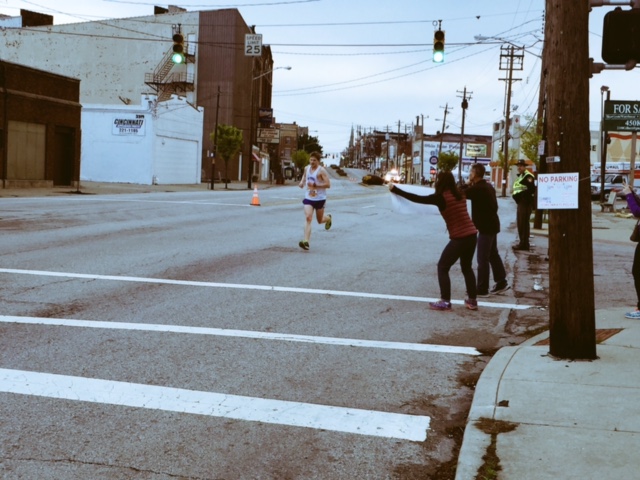
En route, with Mom cheering on the right. The sign says "Run, Jack, run!" It was good advice.
Nor was anyone else, other
than the lead vehicle, in front of me. I was alone, in first place, leading the
entire field of the Flying Pig, as I headed into Eden Park, a little more than
6 miles into the race.
As Gilbert Avenue heads into Eden Park, the terrain
flattens, but only briefly. Here, the first leg of the Flying Pig Marathon
relay ends. When I saw the place where those people would make their exchange, whenever
the first of them showed up, I could only think of one word: “bastards.” For
unlike they, I had not just the rest of the race but, at that moment, arguably
its most excruciating portion: the climb out of Eden Park. Last year, this was
where the course broke me: I ran a mile above 6:00, became beset with cramps,
and was on the verge of giving up before I dug deep within my soul to find the
strength to recover. But this year, things were different. I was still feeling
strong, I did not feel at all intimidated by being alone at the front or by the
hill. I was ready to prove that I was stronger than I was last year.
And prove it I did. Ascending out of the park, I saw two of
the same sights that marked my ascent last year: an Elvis impersonator, and a
friend, Chris Reischel, cheering me on. Last year, in the delirium of my pain,
or the pain of my delirium, these were almost surreal sights, intrusions into
reality from some earthly, pain-free realm that at that moment forbade me
access. This year, however, they were just spectators, motivators along my
path. Soon I passed them by, and soon the course became (again, briefly) flat
again, marking the 7th mile, by far the course’s toughest, which I
completed in a 5:44. This was, obviously, slower than my other miles, but
acceptable for that part of the race, especially versus last year’s supra-6:00
mile. The last of a series of three grueling uphills took me up Victory Parkway
to East McMillan, another spectator-heavy portion of the race. It was here that
I saw, for the first time, my parents and the sister who drove me to the race,
dutifully cheering me on.
My parents (and my sister, sadly cut off, right edge) cheer me on during the hardest part of the race for me. My favorite picture from the race (courtesy Pete Anderson).
And I was glad of it. For although the race here became
flatter, and the cheers of spectators became louder and more consistent, I
needed all the support I could get. For after having conquered the race’s most
difficult portion, I unexpectedly began to flag slightly here; if not too badly
physically, as my miles remained acceptable, then certainly mentally, during
miles 8-10 (5:28, 5:22, 5:26). I grew impatient with the race’s seemingly
stubborn refusal to take me back in the direction of downtown, its insistence
on continuing to force me up and down (smaller) hills and around turns. In
short, I grew impatient, perhaps bored. I was helped here, again, by my fan
support: I saw my family again, and also one Coach Emeritus Dehring, my St.
Xavier High School track and cross country coach, the man who gave me the St. X
singlet I wore today. There was also the fact that I could sense without looking behind me how close 2nd place was: Whenever I heard the
spectators who had cheered me sounding up again, I knew that he was passing by
them. And he was too close for me to rest on my laurels.
Fortunately, this mentally taxing portion of the race ended soon enough. Beginning
with mile 11, the course finally began to bring me back toward downtown, back
down Gilbert. And this was where the fun began. That which I had struggled
uphill earlier in the race now became an accelerator downhill. I was doubly
helped in this regard by the fact that the bulk of the race seemed, at this
time, to be heading up the hill, so it was lined with both spectators in the
middle of the road and racers on the other side of me. Thus I got plenty of
support as I raced down Gilbert, resulting in a 4:56 (!) mile 11. It’s an easy
part of the race, yes, but a sub-5 mile is a sub-5 mile.
And yet the race was not over. For, I thought, there was no
reason 2nd place wouldn’t be able to take just as much advantage of
the downhill as I had. In fact, with me in his sights as the race entered its
final portion, he might find even more motivation within himself to catch me
than I would to remain in 1st. I had been in the front of the race
now for 5 miles, but despite that, a terrifying paranoia began to beset me. So
many times in my life had greatness been snatched from my grasp. I began to
play in my head the nightmarish vision of being passed, or outkicked, and was
not helped in this regard by being able to see my competitor’s orange singlet
out of the corner of my eye any time I made a turn that allowed me to see him
without breaking my stride.
But I did not let these dark prophecies destroy me. Instead, I turned them into
the extra motivation I needed. I wanted nothing more, in the last two miles of
the race, than to be able to coast to the finish line in victory. But the
specter of 2nd place, in both its current bearer and the possibility
that he would transfer his identity to me, terrified me into continuing to work
hard. I was beginning to grow truly tired by now, but I knew that I couldn’t
care. So I let this intoxicating mix of paranoia and victory lust spur me on.
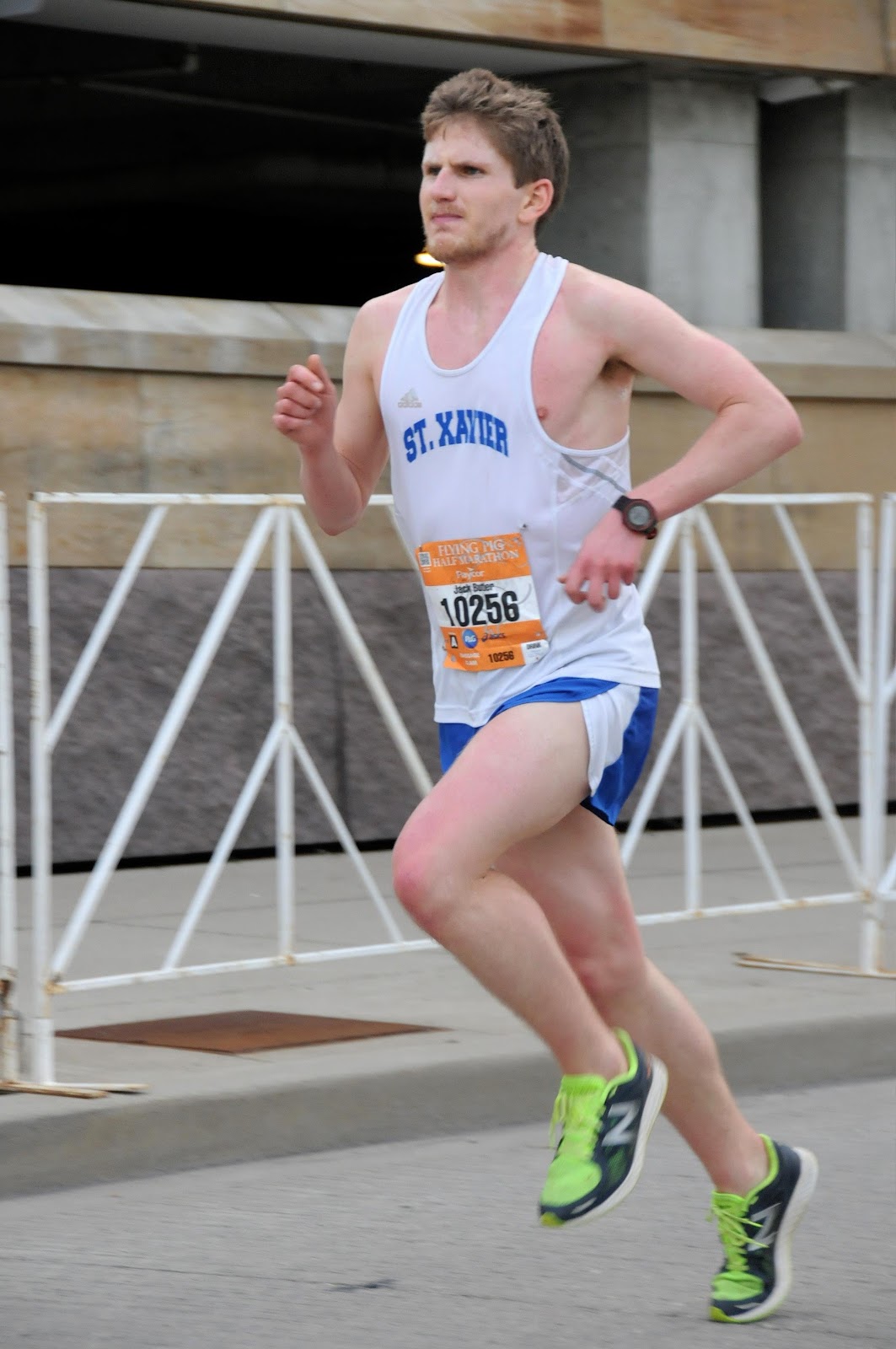
And looking good doing it.
Just before the completion of mile 12 (5:05), the race performs
a bizarre forced turnaround. Last year, when I went through this part of the
race, it allowed 3rd place, on whom I had gained almost 40 seconds
of ground in a furious kick, to see that I was closing in on him, which, alas,
gave him the motivation he needed to keep that from happening. This year, it
allowed me to see, again, that my orange-outfitted competitor was close enough
that I needed to finish strong. I’m now convinced that this part of the course
design is here precisely for this reason.
And so, in the last 1.1 miles of the race,*** I squeezed out every ounce of
energy I had left. I was fortunate to know that the finish line of the race was
different from last year. Getting lost or something like that was not my
concern, not with the lead vehicle, the race spectators, etc. guiding me. But it
was important that I knew, for my own mental purposes, that the finish line was
not where I remembered it, but slightly further away. I continued to follow the
lead vehicle and the race cyclist back toward the heart of downtown, with fewer
meters to go with every step, but still without the finish line in sight.
Around this time, roughly mile 13 (5:10), I randomly saw Brad King, who was
pushing a baby in a stroller. A St.X alum, he cheered me on for my singlet, but
was probably weirded out when I responded by pointing at him and saying “Brad
King.” I do that kind of thing sometimes. But despite the distraction, I was
starting to wonder if I would ever finish.
Then…there it was. Much further off than I expected, I could
see the “Finish Swine,” with that unbroken race tape, waiting for me to be the
one to break it. It was so close, yet so far away. The combination of that, and
the departure of the lead vehicle from in front of me, as well as the cyclist
who had been leading me, from the course, all combined to elicit a “shit” from
my parched racing mouth. It was quite true what the cyclist said to me as he
left the course: “You’re on your own for the rest.”
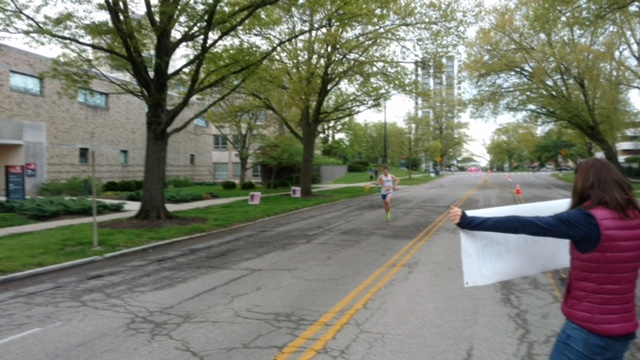
With 2nd place not worryingly close to me, with
all the finish line’s spectators cheering me and me alone on, I charged toward
the finish as hard as I could manage****. Even then, with victory obvious and
imminent, I still couldn’t believe what was actually happening. I was still
afraid of a last-minute surge from someone else that would take everything away
from me just before the end, forcing me to watch as my glory was stolen before my
very eyes, as has happened to me so many times before.
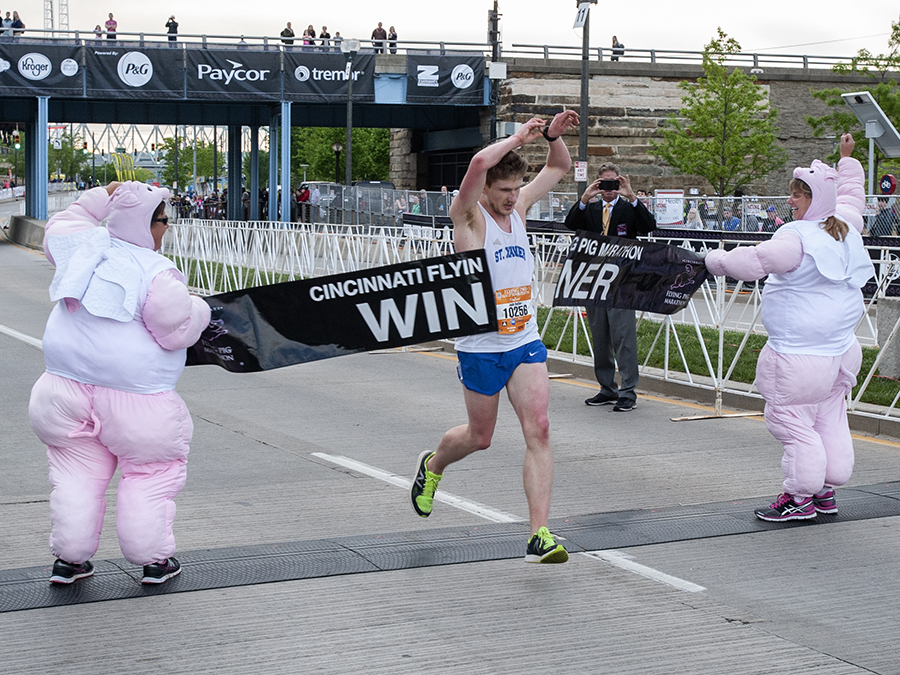
But that moment never came. Meters before the finish line, I
crossed my arms in an X-formation, honoring my past (and my singlet). And then
I crossed the line, broke the tape, and earned victory. With a time of 1:10:39,
I was the 2018 Flying Pig Half Marathon champion, the first runner to cross the
line for any race that day.
You might expect the immediate
aftermath of such an experience to be something of a blur: Heady with victory,
and exhausted from the effort, would the memories really stick? But I can
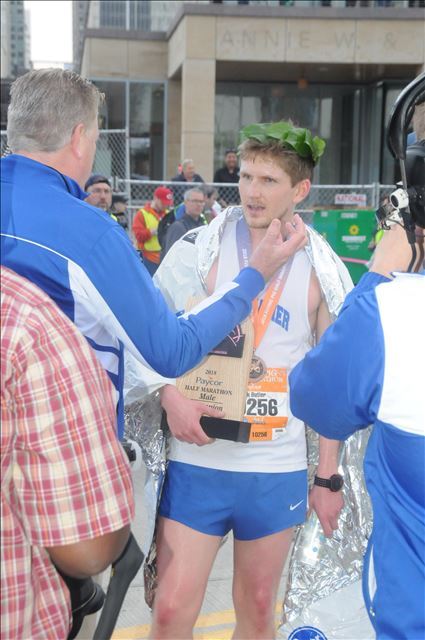
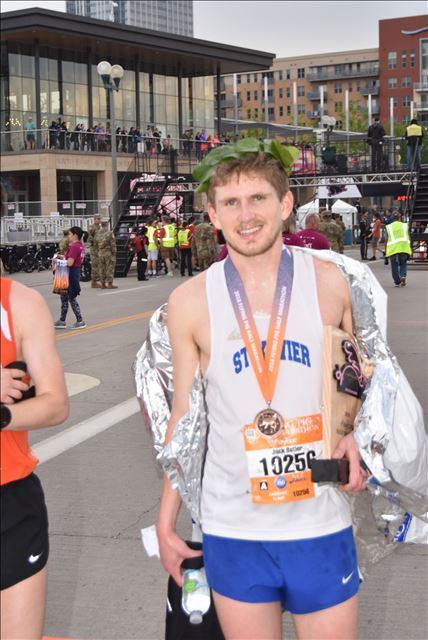
assure you, they did. Just after I crossed the line, I was given my medal and
plaque, the victory laurel was placed upon my head, and I was wrapped in one of
those weird blanket things. I was then interviewed by WLWT, a local news
station, in a surprisingly cogent performance for someone who just won a
half-marathon. And fortunately for me, even if I did not remember what happened
to me after I finished, it was all captured on the WLWT video of my interview,
which you can watch here (also embedded below):
I spent a good 10-15 minutes after finishing in the finish
line corral, doing more interviews, taking pictures, and talking with 2nd
place. His name is Zack Beavin, and he ran a 2:30 at the Boston Marathon this year, so he was probably not at
full strength. I told him as much when I learned that, in addition to thanking
him for working with me in the race. I told him I couldn’t have done it without
him, and I hold to that; we worked together through mile 6, and then the possibility
that he might still beat me made me paranoid enough to finish strong. Thanks,
Zack. May we run against each other again someday.
Once I left the finish line corral, I was quickly found by my aunt and uncle,
who were there to support my cousin Ben (their son), who was running the
marathon, and me. They congratulated me, declined to hug me (because I was so
sweaty), and graciously held some of the swag I had won when I decided to try
going on a cooldown.
Anyway, though…holy crap. I thought I might be able to win
today. But I actually did it. No asterisks. No qualifications. And not only did
I win. I blew my apparently modest goal of setting a personal record out of the
water. Before today, my fastest half-marathon was the 1:12:40 I basically
jogged in preparation for the Marine Corps Marathon last fall. So I dropped 2
minutes off my PR. And I dropped almost three minutes off my time on basically
the same course as last year. I knew I raced last year not at full strength,
but still…3 minutes! Wow. I don’t really have much else to say.***** When I
dream about races, they usually end badly, with some last-minute catastrophe
keeping me from victory. The aftermath of this race felt, at times, like a
dream. But I knew it wasn’t, because in the dreams I never win. Thanks to the Flying Pig for making my reality better than my dreams.
I spent the rest of this day, as you might imagine, sore,
tired, bowel-troubled, but completely and utterly satisfied. I’ve been running
seriously for more than 10 years now, but I think this is by far one of my
greatest running accomplishments yet.******
“But the main takeaway about this race, for me and for everyone who know me
(especially those who may compete against me), is that this won't be my last
half-marathon. Indeed, it was only my first. And now that I have the experience
under my belt, I expect only to get better and better at this race. For I have
now proven, to myself and to anyone who may have doubted me, that graduating
from college was not the end of my competitive running career.
It was only the beginning.”
2017 Jack was right, in more ways than he could have known. My competitive running
career has only just begun. And though I, for once in my life, actually did
exactly what I set out to do, let no one think this means I am done. There are other
races to run, and to win. Tennyson put it better than I could:
Yet all experience is an arch wherethro' Gleams
that untravell'd world whose margin fades
For
ever and forever when I move.
How
dull it is to pause, to make an end, To
rust unburnish'd, not to shine in use!*******
Now,
if you’ll excuse me, it’s time to shine in use.
Notes:
*The Flying Pig uses for its first three miles the last
three miles of the Thanksgiving Day Race, the last race I ran in Cincinnati.
**I drank slightly too much water early on in the race, and
I felt ever-so-slightly waterlogged, so I stopped with it early on and never
hydrated subsequently. I also had to be careful not to grab Gatorade by
mistake, which I did last year and which I think negatively affected me.
***The Flying Pig uses for its last two miles the first two
miles of the Thanksgiving Day Race, the last race I ran in Cincinnati.
****My watch says the last portion of the race for me was
.31 miles, and that I ran it in 1:32.71. So I ran 13.31 miles in 1:10:40
(according to it), which is 5:19 pace. Man, I need to work on those tangents.
*****Other than this: According to my preliminary research
into past Flying Pig Half Marathon results, my performance today ranks 6th
all time:
Tommy Kauffmann - 1:08:30 (2017)
Chris Reis - 1:09:09 (2009)
Todd Pthlek - 1:09:22 (2008)
Thomas Lentz - 1:10:02 (2007)
Mike Griewe - 1:10:36 (2007)
Jack Butler - 1:10:39 (2018)
The funny thing is I know three of these people.
******I still have a tendency, a holdover from running in
high school and college, to think of my running career in terms of “seasons.”
In that sense, the Fall 2017 and Spring 2018 “seasons,” and the 2017-2018 “year”
overall, have been among my best ever for running:
Fall 2017:
-September: Navy Air Force Half Marathon: 1:12:40, 9th
-October: Marine Corps Marathon: 2:34:29, 15th
-November: Cincinnati Thanksgiving Day Race: 33:07, 4th
Spring 2018:
-April: Cherry Blossom 10-miler: 53:15, 46th
-May: Flying Pig Half Marathon: 1:10:39, 1st
Not bad!
*******Unless I’m just totally hallucinating, I think I
quoted this part of the poem from memory to one of the news crews that
interviewed me at the finish line.
When Star Wars: Episode VII - The Force Awakens came out in 2015, it brought a perhaps unprecedented level of hype and subsequent critical and commercial attention. There hadn't been a Star Wars movie in 10 years, and the last time there was one, it was the concluding chapter of the largely-loathed prequel trilogy, which also did not move forward the story last updated in 1983's Return of the Jedi.
The Force Awakens was also the first Star Wars movie to be released in what I call the "take economy," that large sector of the Internet (and other places, I guess, but mostly the Internet) powered by fans and obsessed with dissecting, reviewing, critiquing, and theorizing about pop culture. As a result, The Force Awakens generated a heretofore-unseen level of takes (some of them on this very blog). A large portion of these takes seemed critical of the movie, which I thought was mostly misguided, for reasons explained here.
The one criticism I granted some merit was that The Force Awakens seemed a bit...familiar. This critique deserves many, many qualifications. But the most important of them was that it would be impossible to judge The Force Awakens on its own merits, in isolation from the new trilogy of which it would be a part. As the first installment, it reacquainted us with the universe while also establishing the possibility for significant creativity and novelty in future installments. It would only be possible to judge The Force Awakens, then, and the new trilogy as a whole, upon its completion; too many critics were trying to judge aspects of its narrative best seen in conjunction in isolation, and in comparison with a trilogy already completed in 1983. This seemed unfair.
You may remember this movie
But with the release of Star Wars: Episode VIII - The Last Jedi, we have a better sense of how to judge this new trilogy. The Last Jedi has many of the trappings of a Star Wars film: there are lightsabers, wars in stars, Force powers, etc. But in many other ways, The Last Jedi actively subverts what we've come to expect from Star Wars, introducing new characters, new themes, and new scenarios and setpieces, and taking the story in surprising new directions. It is not entirely successful at all of this, largely due to a somewhat unfocused, flabby narrative (at 2 hrs and 30 minutes long, The Last Jedi is the longest Star Wars movie), and some creative risks that do not pay off. Yet the successes in this regard definitely outweigh the failures of what ultimately remains thoroughly a Star Wars movie.
The Last Jedi begins with its first subversion: It seems to take place immediately after the end of The Force Awakens (whereas all previous Star Wars movies have at least some gap between them), with the Resistance (the reduced successor to the original trilogy's Rebellion) on the run from the First Order (the not-much-reduced successor to the original trilogy's Empire). Meanwhile, Rey (Daisy Ridley) has arrived at the hideaway of Jedi Master Luke Skywalker (Mark Hamill), seeking his wisdom and his aid in the fight.
This setup seems at least somewhat redolent of The Empire Strikes Back, The Last Jedi's original trilogy equivalent. But The Last Jedi quickly takes this framework and moves it in strikingly different places. On the Resistance-First Order side of things, the Resistance, led by Leia Organa (the late Carrie Fisher) is in more dire straits than the Rebellion ever was, with a tiny fleet, led by brave but reckless pilot Poe Dameron (Oscar Isaac), and hounded by the First Order's relentless ships. And Rey finds, in seeking the counsel of Luke, that he has essentially given up on the Jedi (whom he considers failures), the Force (from which he has cut himself off), and the Resistance (which he thinks no one can help). And Rey, the seemingly eager pupil, finds herself mysteriously connected and drawn to the tormented villain Kylo Ren, a.k.a. Ben Solo (Adam Driver), who is likewise drawn to her.
They have a history
To reveal where The Last Jedi goes with all of this would be to ruin a movie you should definitely see for yourself (and perhaps more than once; it took me two viewings to appreciate fully). But it is not a spoiler for me to reveal that the movie takes the raw materials of its plot in unexpected and subversive directions. And perhaps the most impressive direction is a narrative theme that is more mature and complex than any previous Star Wars movie: failure. Virtually every character in the movie confronts failure in some way. Their reactions to their failures determine the directions of their characters: some learn from them, others take the wrong lessons from them, and still others fail to grow at all from them, to their own detriment and folly.
It would also not be a spoiler for me to reveal that the movie does new things with the trappings of Star Wars that keep its universe interesting in a fashion I no longer considered possible. You'd think there are only so many things to do with the Force, with lightsabers, with space battles, and with the basic dynamic of good-vs-evil. But The Last Jedi does fresh things with each of these archetypes, a testament to its creative risks.
Not all of The Last Jedi's creative risks pay off, however. It is too long and somewhat disorganized, a noticeable contrast to the clean, clear, three-act structure of The Force Awakens. It is somewhat too packed with ideas, many, if not most, of which are intriguing but not all of which get full exploration. Many of its deliberate subversions of fan expectations served to keep the story surprising, but some of them seemed a bit unfair, and deserve at least some addressing in Episode IX - The Spark of Hope (or whatever it's called). The Last Jedi also does not seem to know really what to do with Finn (John Boyega), who gets a bit lost in the sprawl of its narrative.
But these flaws do not add up to a movie that deserves the hatred many seem to have given it. It is absurd to claim it is worse than any of the prequels, or that any character in it is worse than Jar Jar Binks, but many have claimed precisely this. If these and other critics, in overabundant supply in the take economy, are angry at The Last Jedi for straying from their expectations of what should have happened, or deviating from their own fan fiction or fan theories (something to which I could have related, having written some fan speculation of my own), then they are misguided. If Star Wars only conforms to preestablished expectations, then it will stop being interesting very soon, in a galaxy very, very close to us. There are criticisms to be made of the The Last Jedi, but a failure to be interesting is certainly not one of them.